Ontario Ministry of Natural Resources
Provincial ministry managing Crown forests, lands, water and wildland fire; was "Natural Resources and Forestry" until 2024.
Visit OrganizationResources from this organization
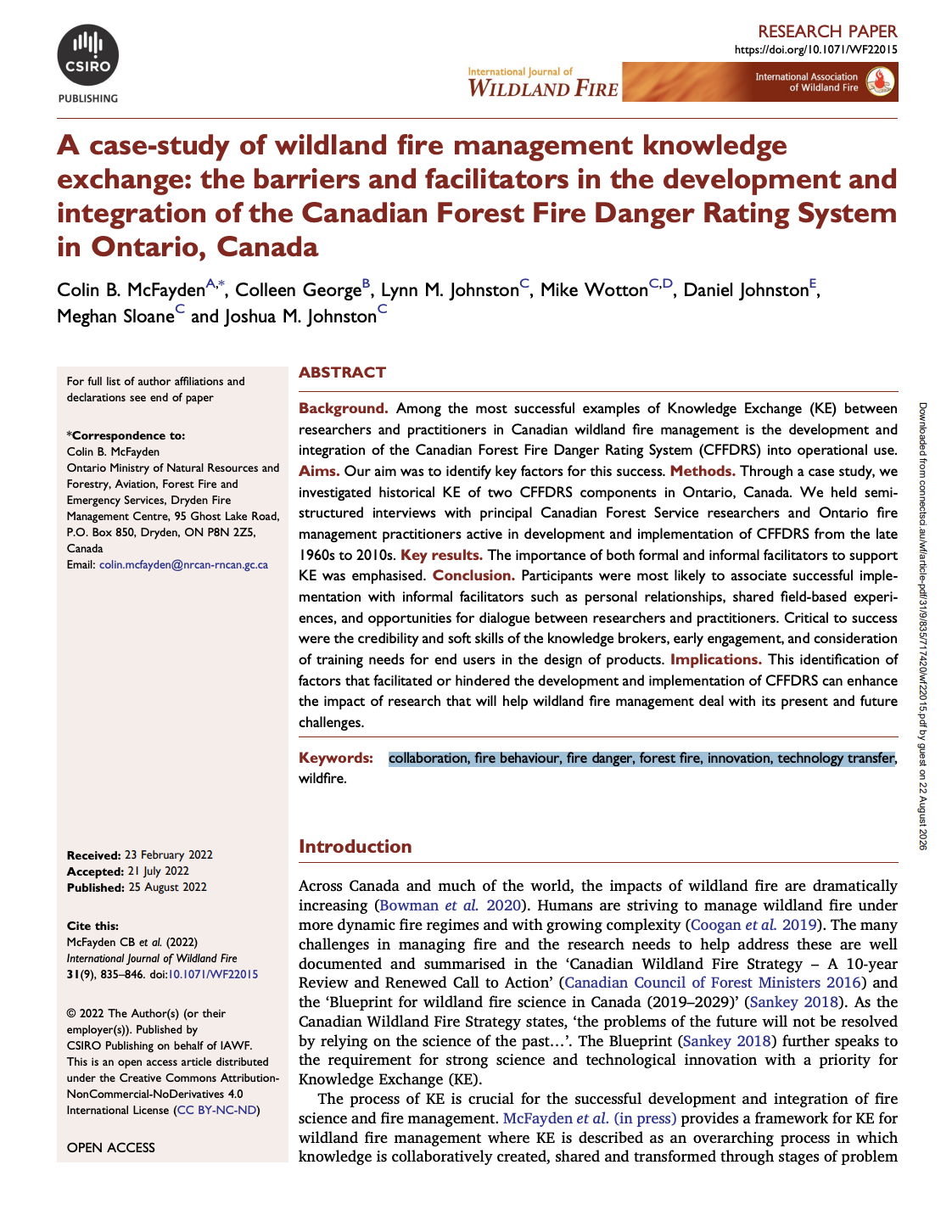
A case-study of wildland fire management knowledge exchange: the barriers and facilitators in the development and integration of the Canadian Forest Fire Danger Rating System in Ontario, Canada
Among the most successful examples of Knowledge Exchange (KE) between researchers and practitioners in Canadian wildland fire management is the development and integration of the Canadian Forest Fire Danger Rating System (CFFDRS) into operational use. Our aim was to identify key factors for this success. Through a case study, we investigated historical KE of two CFFDRS components in Ontario, Canada. We held semistructured interviews with principal Canadian Forest Service researchers and Ontario fire management practitioners active in development and implementation of CFFDRS from the late 1960s to 2010s. The importance of both formal and informal facilitators to support KE was emphasised.
Forest fires
Find information about the current danger, activity and fire restrictions of forest fires and grass and brush fires across Ontario.
History and overview of research and development for Ontario’s FireGUARD decision support system for appropriate response
Research and development for a real-time wildfire decision support system was undertaken to support appropriate response decision-making in Ontario, Canada. We describe the context, history, requirements, research and development process, and components of FireGUARD (Fire Growth under Uncertainty for Appropriate Response Decision Support) and show examples of its prototype products. The work was a collaborative effort between researchers, specialists, and fire management experts. FireGUARD prototype outputs include a weather forecast and high-resolution maps of burn probability out to 14 days, fuel type, impact, and risk. Additional uses of include triaging multiple new fires, prioritizing scarce suppression resources, and large fire management. FireGUARD was very useful and remains in demand; its success led to further decision-support initiatives. Supplementary materials including fact sheets and technical summaries are available on this landing page beneath the references.
Impacts of wildland fire effects on resources and assets through expert elicitation to support fire response decisions
A modelling framework to spatially score the impacts from wildland fire effects on specific resources and assets was developed for and applied to the province of Ontario, Canada. This impact model represents the potential ‘loss’, which can be used in the different decision-making methods common in fire response operations (e.g. risk assessment, decision analysis and expertise-based). Resources and assets considered include point features such as buildings, linear features such as transmission lines, and areal features such as forest management areas. Three categories of fire impacts were included: social, economic and emergency response. Category-specific scores were determined through expert elicitation and then adjusted to account for fire intensity. Expert elicitation was shown to compare favourably with other methods in terms of the complexity, time, set-up cost and operational use. When compared with historical fire data from Ontario, it was found that impact model scores were associated with the objective to suppress or monitor fires. The model framework provides a consistent pre-fire impact assessment to support individual fire response decisions. The impact assessment can also represent the total impact for areas of Ontario that do not have prescriptive response in a formal fire response plan.
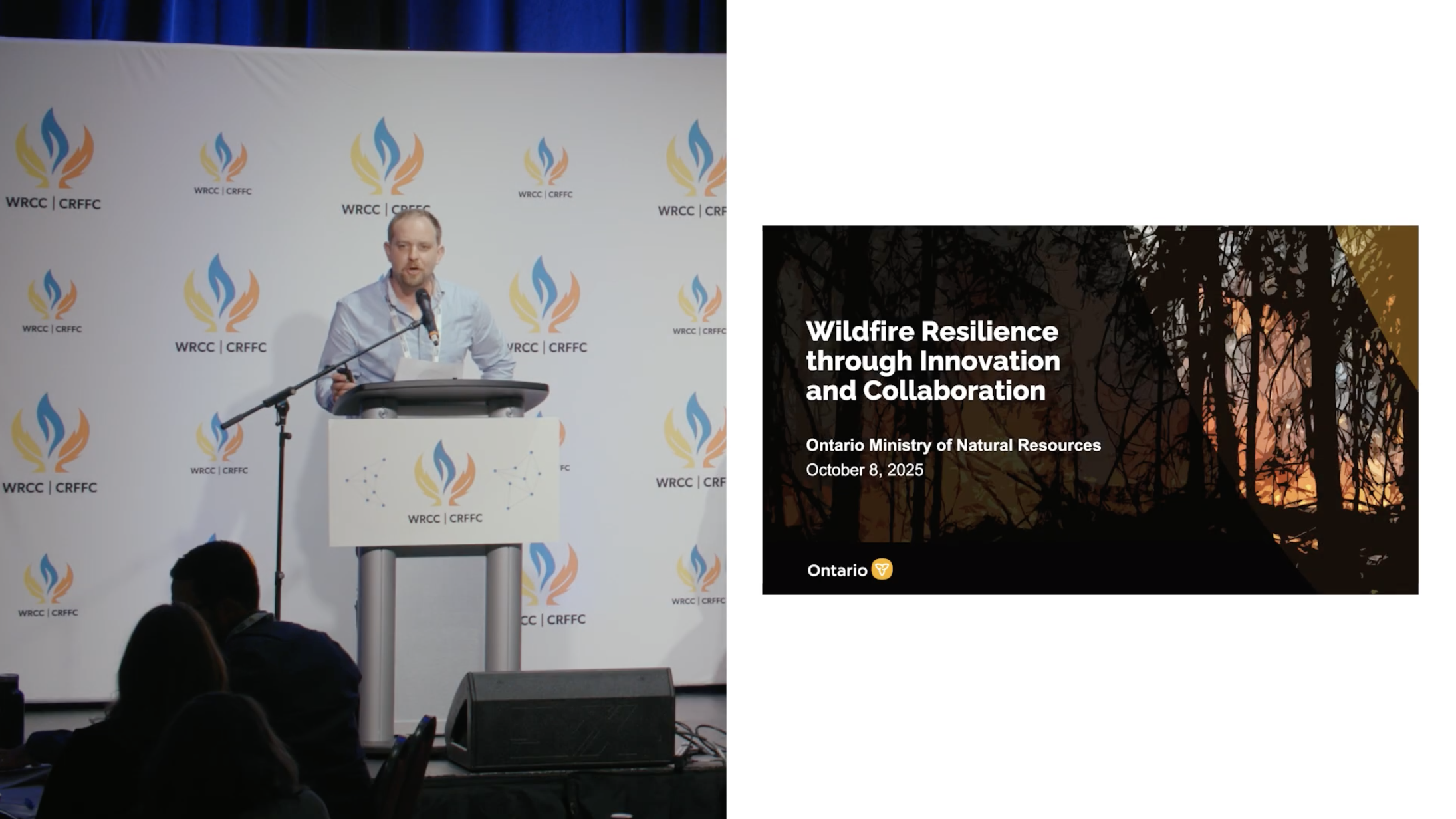
Improving Wildfire Resilience Through Innovation and Collaboration in Ontario’s Managed Forest Landscapes
The Ontario Ministry of Natural Resources is spearheading a research portfolio of 11 interconnected projects in stand management, community leadership, and landscape management, which seeks to reconceptualize the role of forest management in influencing wildfire patterns throughout Ontario. This presentation was featured as a short “lightning talk” at the 2025 WRCC Building Foundational Knowledge Gathering, where recipients of Wildfire Resilient Futures Initiative (WRFI) funding from Natural Resources Canada shared key takeaways of their projects and demonstrated how their work is contributing to a more wildfire resilient future.
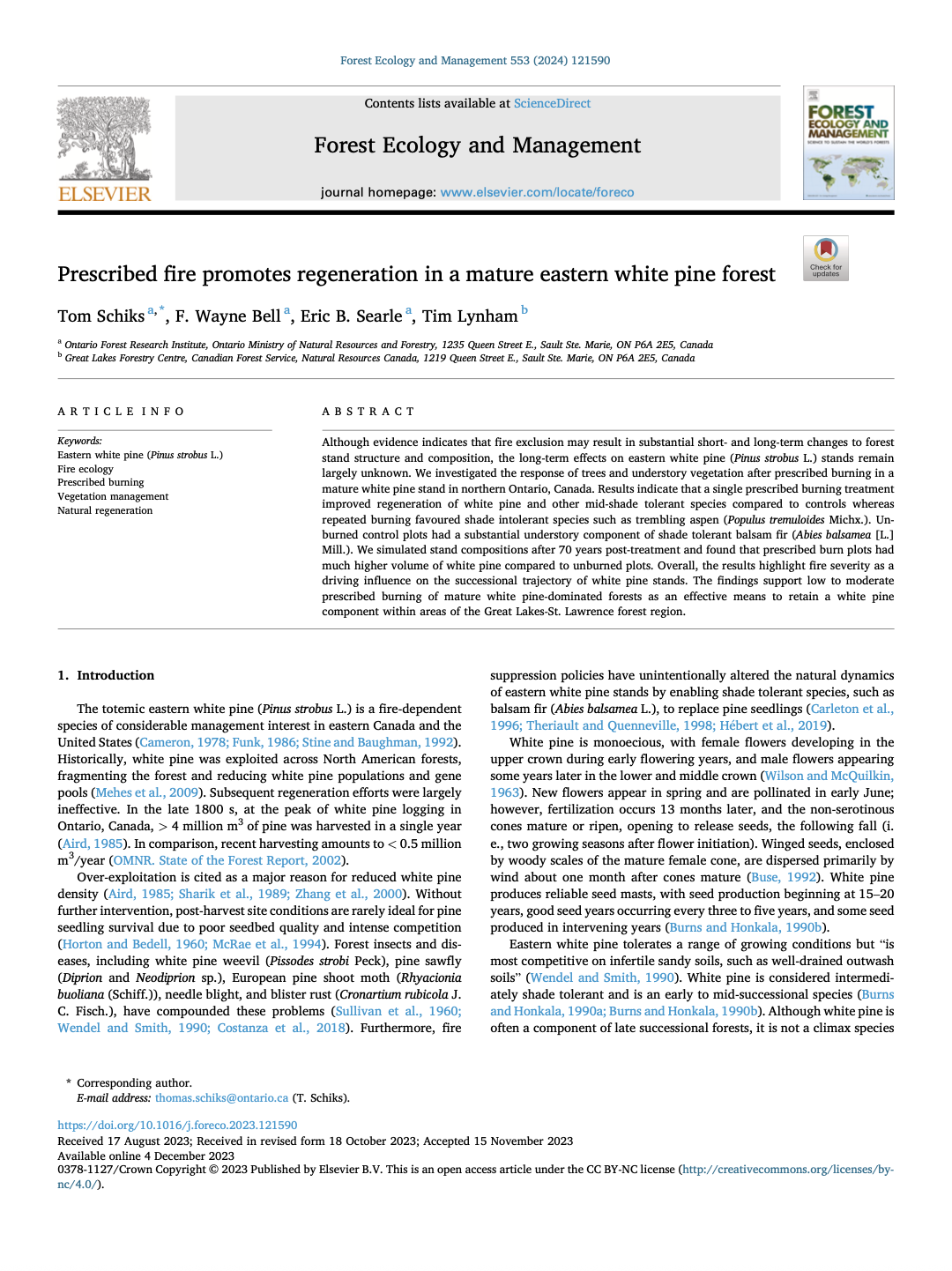
Prescribed fire promotes regeneration in a mature eastern white pine forest
Although evidence indicates that fire exclusion may result in substantial short- and long-term changes to forest stand structure and composition, the long-term effects on eastern white pine (Pinus strobus L.) stands remain largely unknown. We investigated the response of trees and understory vegetation after prescribed burning in a mature white pine stand in northern Ontario, Canada. Overall, the results highlight fire severity as a driving influence on the successional trajectory of white pine stands. The findings support low to moderate prescribed burning of mature white pine-dominated forests as an effective means to retain a white pine component within areas of the Great Lakes-St. Lawrence forest region.
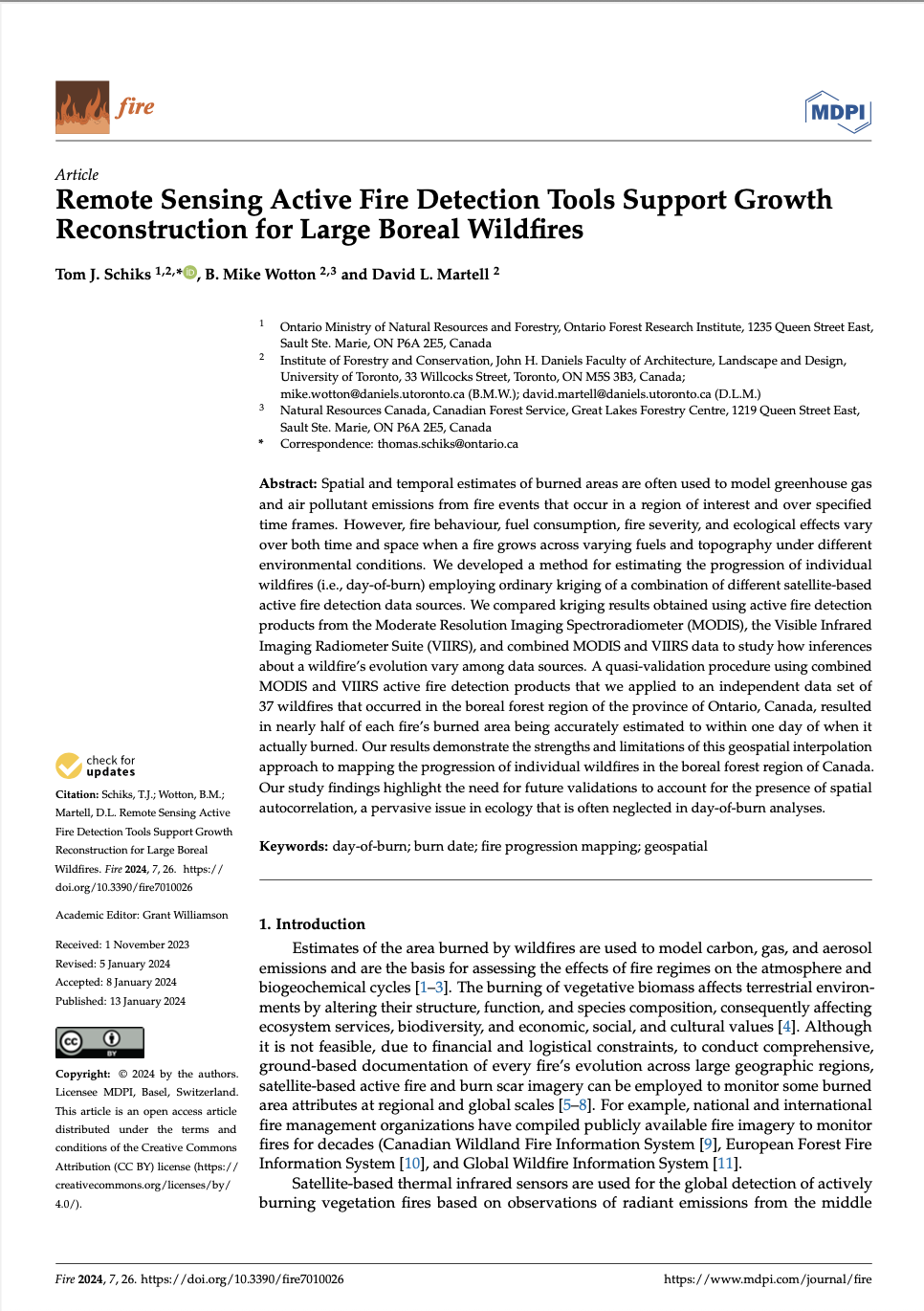
Remote Sensing Active Fire Detection Tools Support Growth Reconstruction for Large Boreal Wildfires
Spatial and temporal estimates of burned areas are often used to model greenhouse gas and air pollutant emissions from fire events that occur in a region of interest and over specified time frames. However, fire behaviour, fuel consumption, fire severity, and ecological effects vary over both time and space when a fire grows across varying fuels and topography under different environmental conditions. We developed a method for estimating the progression of individual wildfires (i.e., day-of-burn) employing ordinary kriging of a combination of different satellite-based active fire detection data sources. Our results demonstrate the strengths and limitations of this geospatial interpolation approach to mapping the progression of individual wildfires in the boreal forest region of Canada. Our study findings highlight the need for future validations to account for the presence of spatial autocorrelation, a pervasive issue in ecology that is often neglected in day-of-burn analyses.
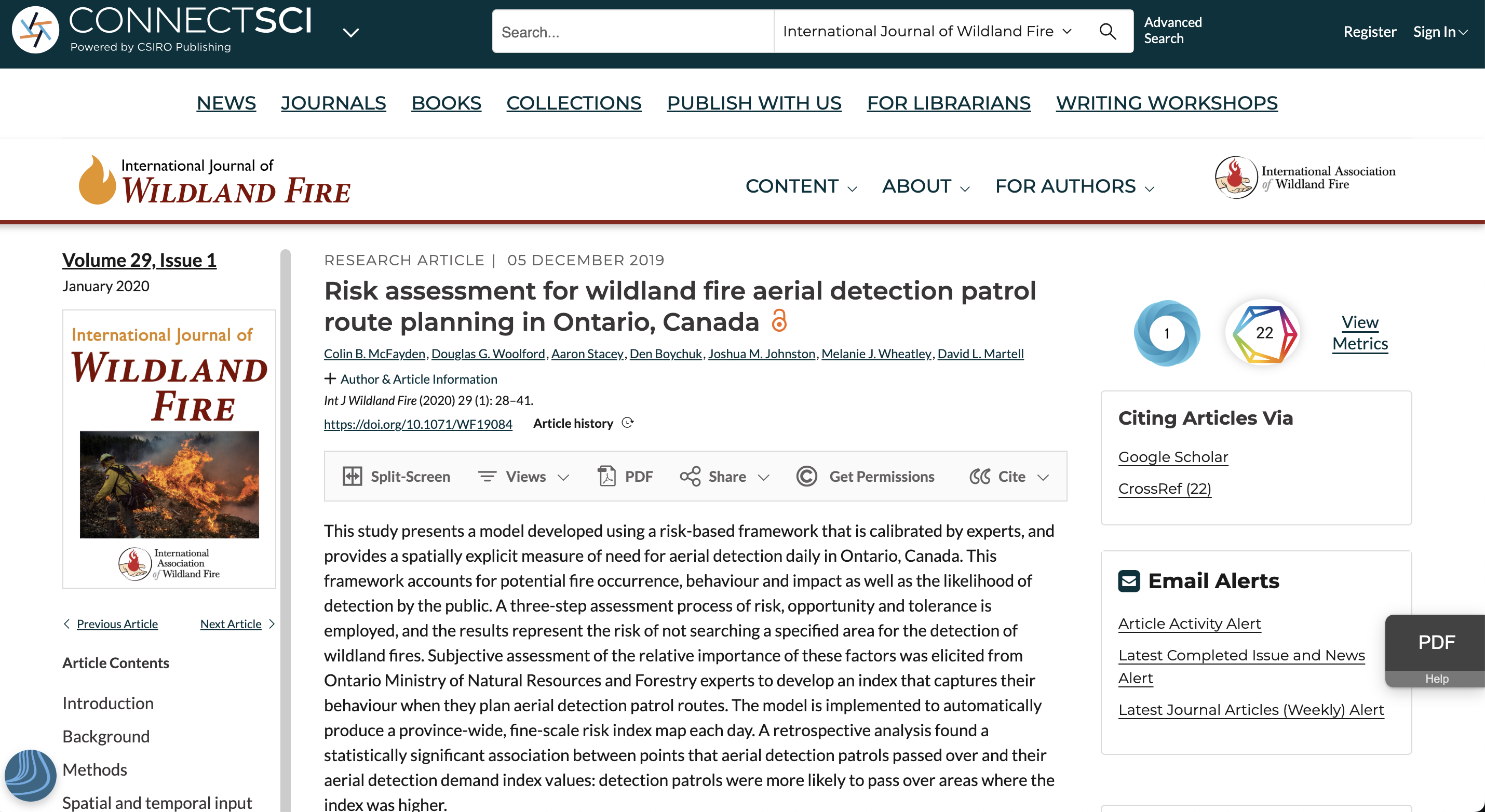
Risk assessment for wildland fire aerial detection patrol route planning in Ontario, Canada
This study presents a model developed using a risk-based framework that is calibrated by experts, and provides a spatially explicit measure of need for aerial detection daily in Ontario, Canada. This framework accounts for potential fire occurrence, behaviour and impact as well as the likelihood of detection by the public. A three-step assessment process of risk, opportunity and tolerance is employed, and the results represent the risk of not searching a specified area for the detection of wildland fires. Subjective assessment of the relative importance of these factors was elicited from Ontario Ministry of Natural Resources and Forestry experts to develop an index that captures their behaviour when they plan aerial detection patrol routes. The model is implemented to automatically produce a province-wide, fine-scale risk index map each day. A retrospective analysis found a statistically significant association between points that aerial detection patrols passed over and their aerial detection demand index values: detection patrols were more likely to pass over areas where the index was higher.
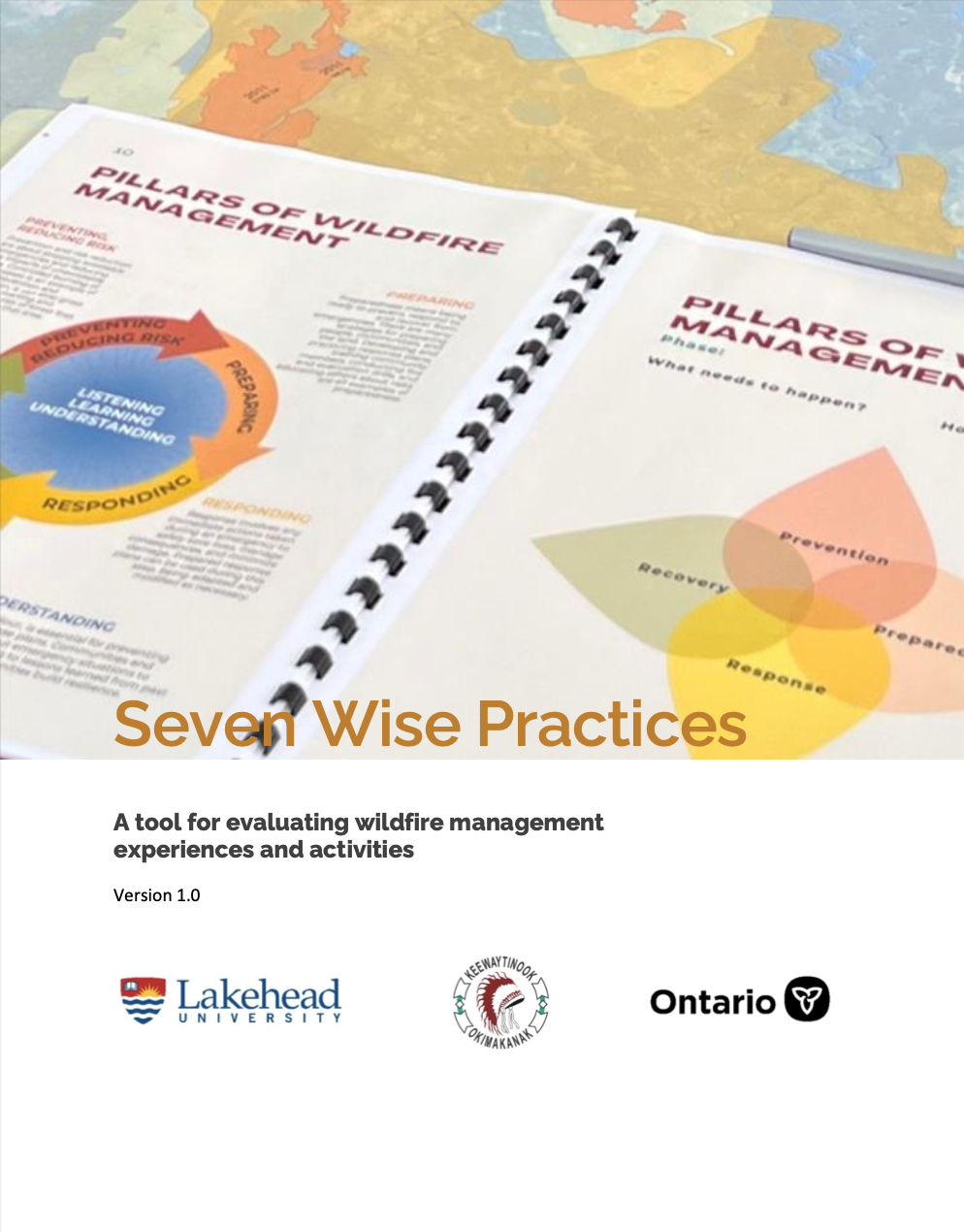
Seven Wise Practices: A tool for evaluating wildfire management experiences and activities: Version 1.0
This tool is intended to provide a structured and adaptable approach for members of First Nation communities and external organizations supporting First Nations to reflect on and evaluate wildfire management experiences and activities. To guide evaluation and learning, we suggest seven wise practices for doing wildfire management with remote First Nations communities. Who should use this tool? • Members of remote First Nations facilitating conversations about wildfire management or fire-related evacuations • Members of external organizations involved in wildfire management with remote First Nation communities • Tribal Council or other support organization staff looking to evaluate their wildfire management and evacuation approaches • Wildfire management practitioners and researchers This work is licensed under a Creative Commons Attribution-ShareAlike 4.0 International License. The license can be viewed at https://creativecommons.org/licenses/by-sa/4.0/
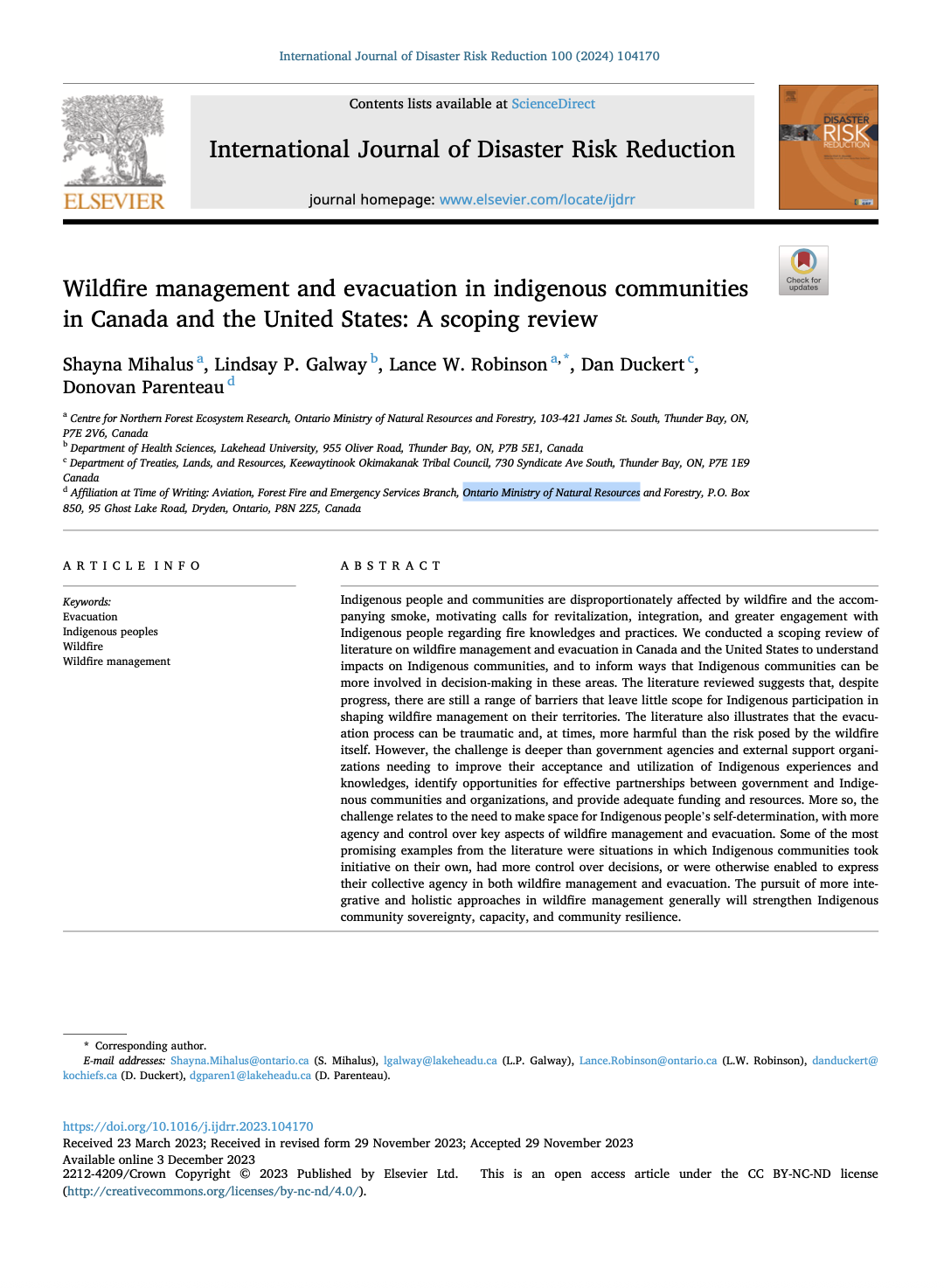
Wildfire management and evacuation in indigenous communities in Canada and the United States: A scoping review
Indigenous people and communities are disproportionately affected by wildfire and the accompanying smoke, motivating calls for revitalization, integration, and greater engagement with Indigenous people regarding fire knowledges and practices. We conducted a scoping review of literature on wildfire management and evacuation in Canada and the United States to understand impacts on Indigenous communities, and to inform ways that Indigenous communities can be more involved in decision-making in these areas.