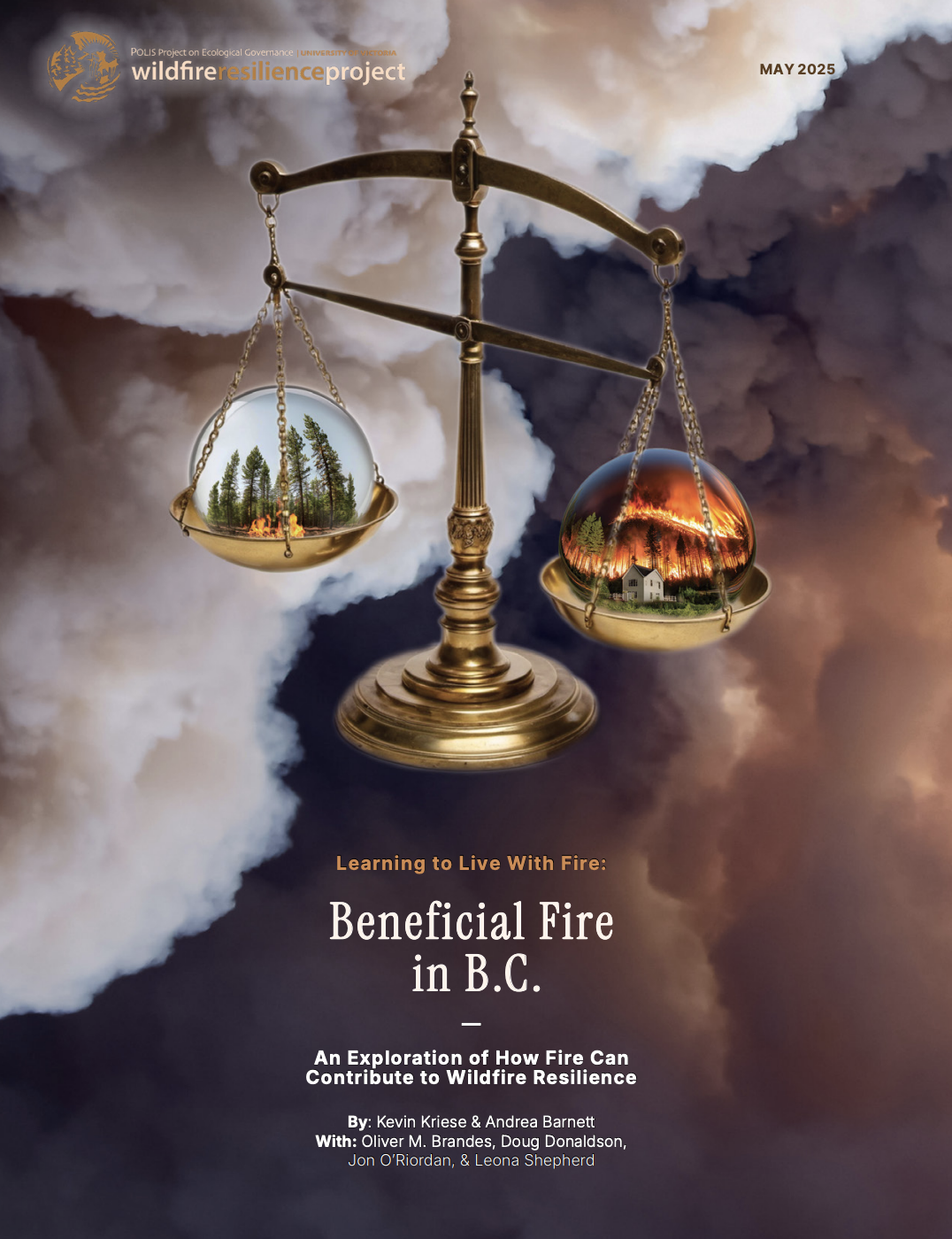
Learning to Live With Fire: Beneficial Fire in B.C. - An Exploration of How Fire Can Contribute to Wildfire Resilience
This report explores the meaning of beneficial fire and introduces a conceptual framework to help evaluate current and future wildfires on a gradient between beneficial and detrimental. It then describes how the concept of beneficial fire can guide planning, management, and decision making. This report is meant to be a discussion starter. Our goal is to encourage dialogue about the kinds of fires we want today and in the future, including: • Strengthening awareness that fire regimes are different in different places. • Emphasizing that management needs to be tailored to the prevailing and projected fire regime. • Exploring the types of wildland fire that should be encouraged and when it is appropriate to suppress fire. • Promoting the use of managed wildfire (i.e. modified suppression) as a necessary management strategy. We close with some actions that can be taken now as part of a whole-of-society approach to promote beneficial fire as one aspect of a pathway towards wildfire resilience. Our intended audience is a wide range of managers, policymakers, and policy influencers working in fields connected to wildfire and resilience in B.C. This includes Indigenous governments, local governments, the provincial government (including, but not limited to, the BC Wildfire Service), industry, and civil society.
Le présent rapport explore la notion d’incendie bénéfique et propose un cadre conceptuel visant à faciliter l’évaluation des feux de forêt actuels et futurs sur un gradient allant de bénéfique à néfaste. Il décrit ensuite comment le concept d’incendie bénéfique peut orienter la planification, la gestion et la prise de décision. Ce rapport se veut un point de départ pour la discussion. Notre objectif est d’encourager le dialogue sur les types d’incendies que nous souhaitons aujourd’hui et à l’avenir, notamment : • Renforcer la prise de conscience du fait que les régimes d’incendie varient d’un endroit à l’autre. • Souligner que la gestion doit être adaptée au régime de feu actuel et prévu. • Examiner les types de feux de forêt qui devraient être favorisés et déterminer quand il est approprié de les éteindre. • Promouvoir le recours aux feux de forêt contrôlés (c’est-à-dire la suppression modifiée) comme stratégie de gestion nécessaire. Nous concluons en proposant certaines mesures qui peuvent être prises dès maintenant dans le cadre d’une approche impliquant l’ensemble de la société afin de promouvoir les feux bénéfiques comme un élément de la voie menant à la résilience face aux feux de forêt. Notre public cible est constitué d’un large éventail de gestionnaires, de décideurs et d’acteurs influents travaillant dans des domaines liés aux feux de forêt et à la résilience en Colombie-Britannique. Cela inclut les gouvernements autochtones, les administrations locales, le gouvernement provincial (y compris, mais sans s’y limiter, le BC Wildfire Service), l’industrie et la société civile.
Authors
- Kevin Kriese
- Jon O’Riordan
- Andrea Barnett
- Oliver Brandes
- Doug Donaldson
- Leona Shepherd
Organizations
- POLIS Project on Ecological Governance