Faster, bigger, more severe: Extreme wildfire spread sets the stage for forest ecosystem change in western and boreal North America
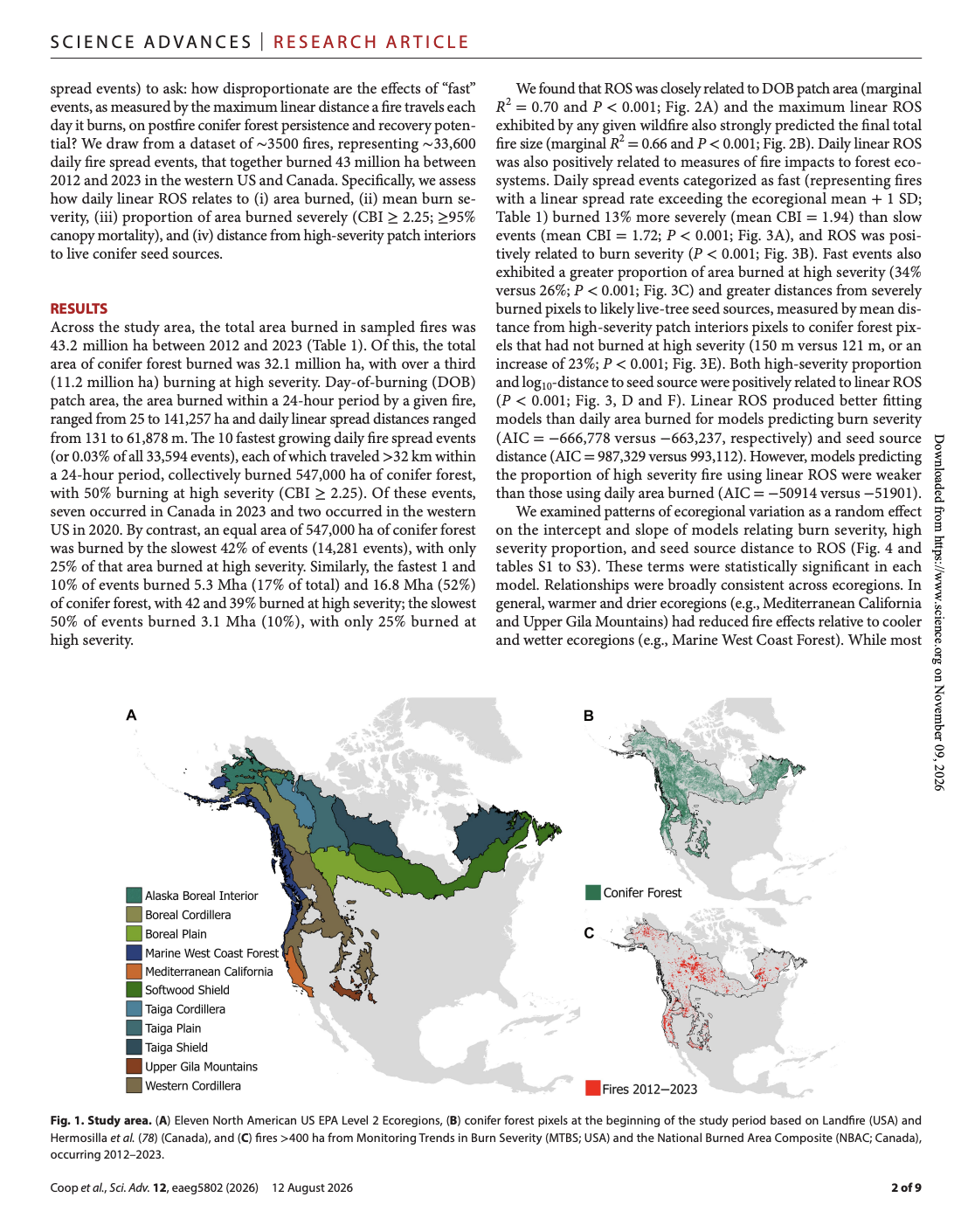
A relatively small number of rapidly spreading wildfire events burn disproportionately large areas. But beyond area burned, do fast fires produce distinct postfire ecological outcomes? Here, we measure daily linear fire growth rates and assess relationships between fire spread, burn severity, and metrics of postfire landscape resilience from 3499 fires occurring between 2012 and 2023 in conifer-dominated forests of Canada and the western US. We find that as linear spread rate increases, so too does fire severity, proportion of area burned at high severity, and distance to surviving live tree seed sources. Thus, not only do the fastest fires burn outsized areas, but these areas have less remaining tree cover and reduced capacity for recovery, setting the stage for long-term vegetation shifts. Given anticipated increases in extreme fire spread as fire seasons lengthen and weather becomes more fire-conducive, our findings highlight growing needs to effectively reduce undesired impacts, manage postfire landscapes to sustain forest ecosystem functions, and foster social-ecological adaptation.
Authors
- Jonathan Coop (Western Colorado University)
- Jared Balik (Western Colorado University)
- Meg Krawchuk (Oregon State University)
- Jessika McFarland (Western Colorado University)
- Cameron Naficy (Oregon State University)
- Marc-André Parisien (Natural Resources Canada - Canadian Forest Service)
- Sean Parks (USDA Forest Service)
- Kyle Rodman (Ecological Restoration Institute)
- Camille Stevens-Rumann (Colorado State University)
- Ellen Whitman (Natural Resources Canada - Canadian Forest Service)