BurnBot
Resources from this organization
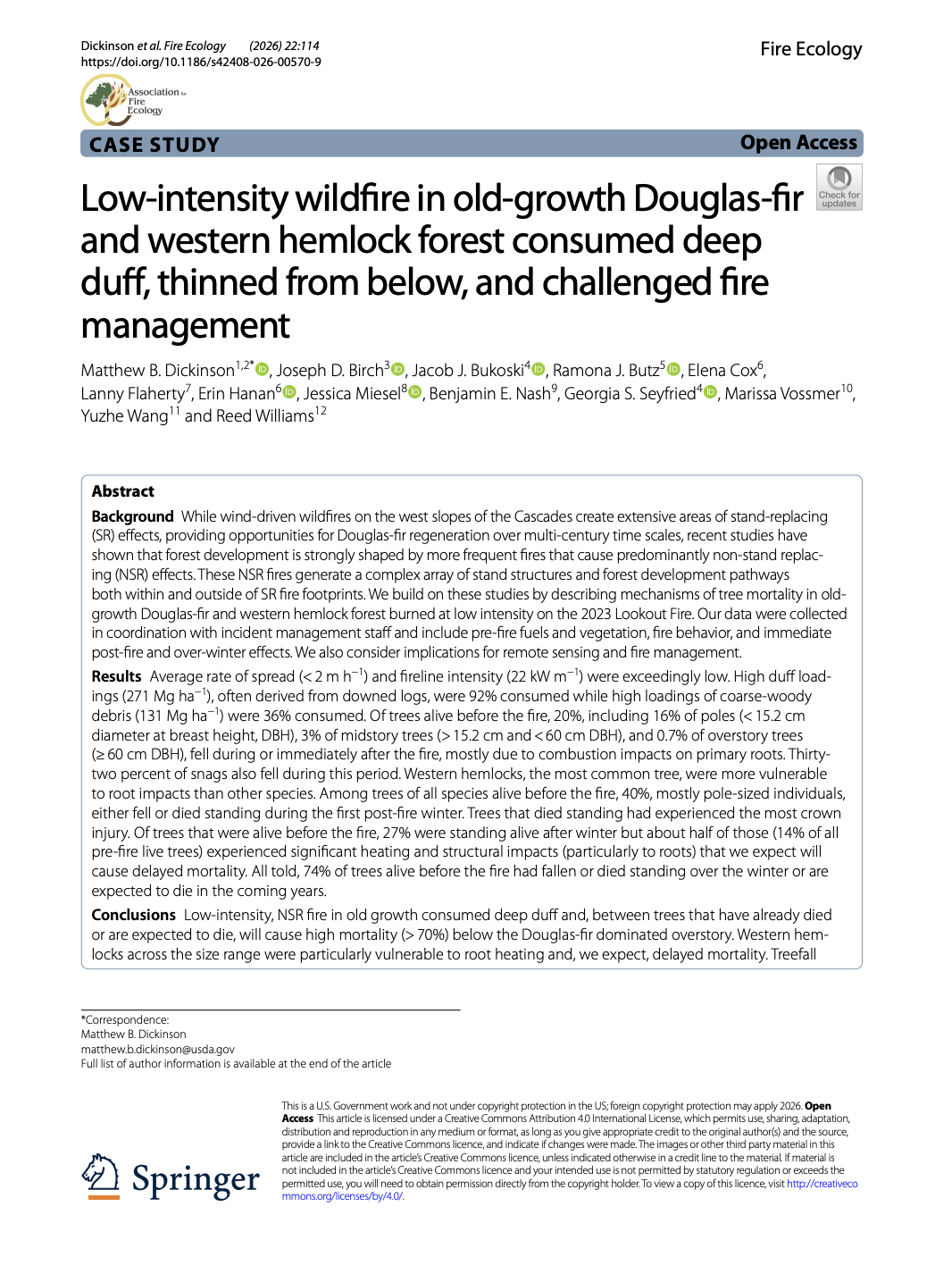
Low-intensity wildfire in old-growth Douglas-fir and western hemlock forest consumed deep duff, thinned from below, and challenged fire management
While wind-driven wildfires on the west slopes of the Cascades create extensive areas of stand-replacing (SR) effects, providing opportunities for Douglas-fir regeneration over multi-century time scales, recent studies have shown that forest development is strongly shaped by more frequent fires that cause predominantly non-stand replacing (NSR) effects. These NSR fires generate a complex array of stand structures and forest development pathways both within and outside of SR fire footprints. We build on these studies by describing mechanisms of tree mortality in old-growth Douglas-fir and western hemlock forest burned at low intensity on the 2023 Lookout Fire. Our data were collected in coordination with incident management staff and include pre-fire fuels and vegetation, fire behavior, and immediate post-fire and over-winter effects. We also consider implications for remote sensing and fire management. Treefall during and immediately after fire along with high loadings of duff and downed logs challenged fire suppression operations on the 2023 Lookout Fire but an understanding of why trees fall could help mitigate future treefall hazards for firefighters along planned control lines.