
Oregon State University
Resources from this organization
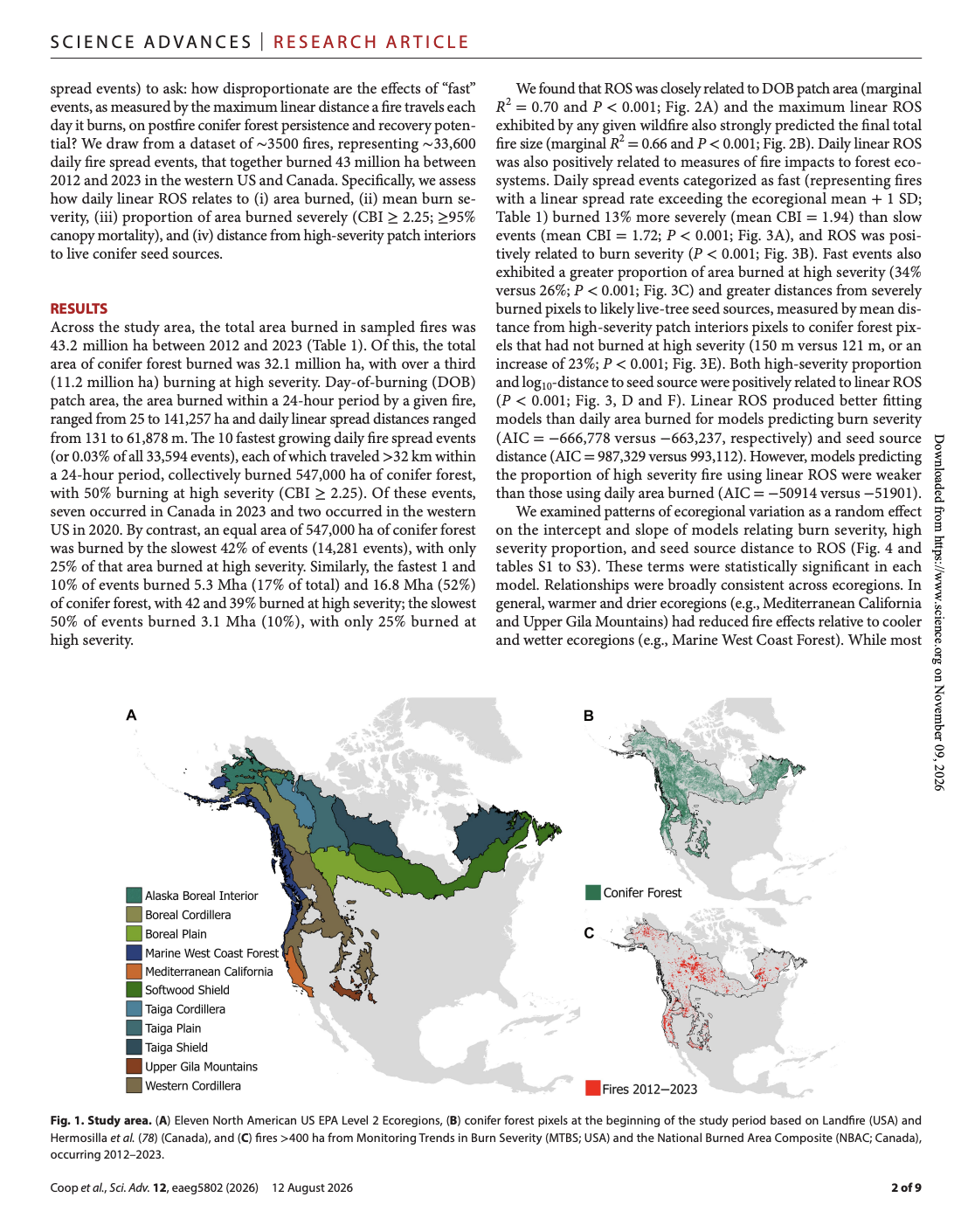
Faster, bigger, more severe: Extreme wildfire spread sets the stage for forest ecosystem change in western and boreal North America
A relatively small number of rapidly spreading wildfire events burn disproportionately large areas. But beyond area burned, do fast fires produce distinct postfire ecological outcomes? Here, we measure daily linear fire growth rates and assess relationships between fire spread, burn severity, and metrics of postfire landscape resilience from 3499 fires occurring between 2012 and 2023 in conifer-dominated forests of Canada and the western US. We find that as linear spread rate increases, so too does fire severity, proportion of area burned at high severity, and distance to surviving live tree seed sources. Thus, not only do the fastest fires burn outsized areas, but these areas have less remaining tree cover and reduced capacity for recovery, setting the stage for long-term vegetation shifts. Given anticipated increases in extreme fire spread as fire seasons lengthen and weather becomes more fire-conducive, our findings highlight growing needs to effectively reduce undesired impacts, manage postfire landscapes to sustain forest ecosystem functions, and foster social-ecological adaptation.
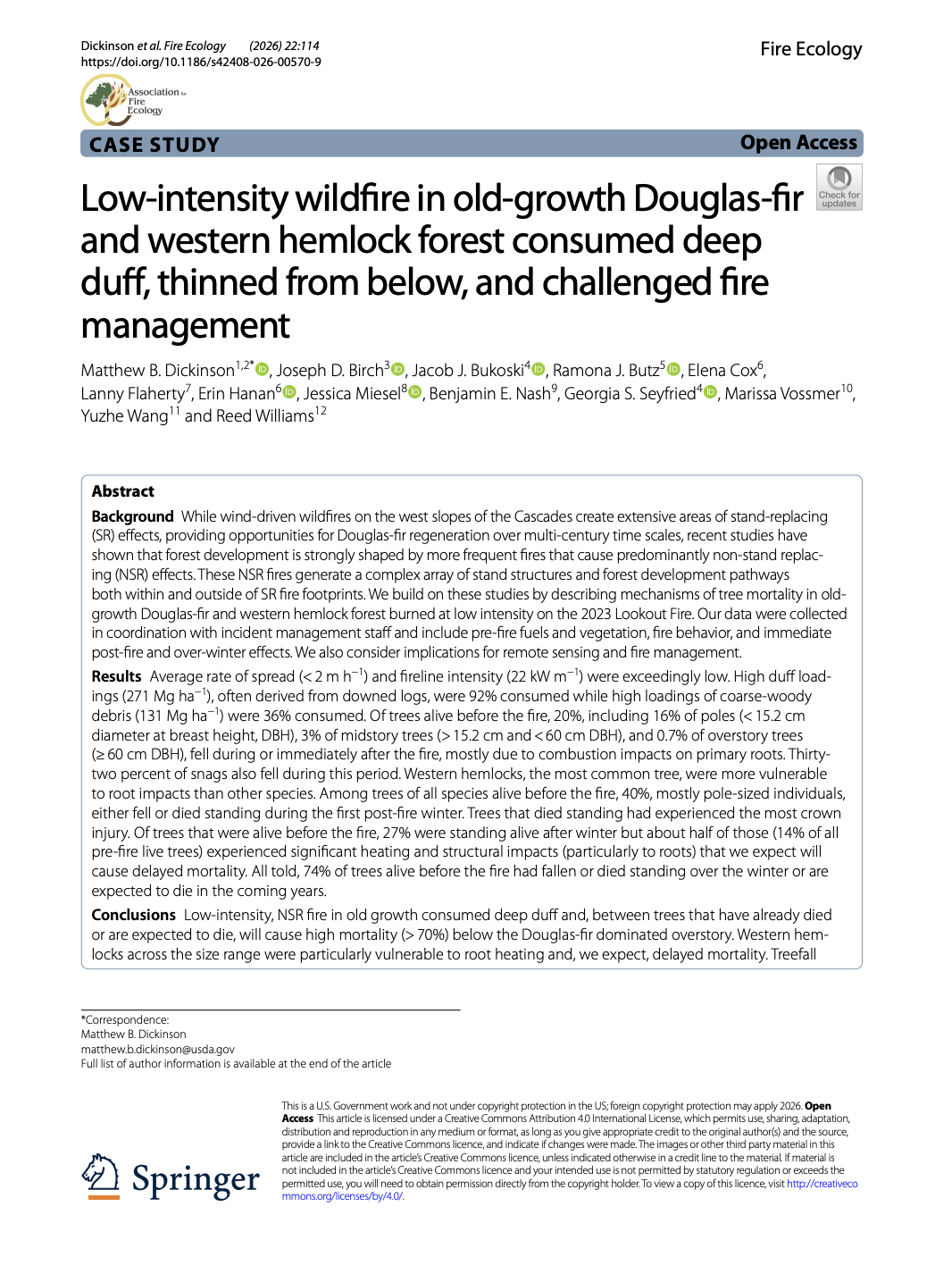
Low-intensity wildfire in old-growth Douglas-fir and western hemlock forest consumed deep duff, thinned from below, and challenged fire management
While wind-driven wildfires on the west slopes of the Cascades create extensive areas of stand-replacing (SR) effects, providing opportunities for Douglas-fir regeneration over multi-century time scales, recent studies have shown that forest development is strongly shaped by more frequent fires that cause predominantly non-stand replacing (NSR) effects. These NSR fires generate a complex array of stand structures and forest development pathways both within and outside of SR fire footprints. We build on these studies by describing mechanisms of tree mortality in old-growth Douglas-fir and western hemlock forest burned at low intensity on the 2023 Lookout Fire. Our data were collected in coordination with incident management staff and include pre-fire fuels and vegetation, fire behavior, and immediate post-fire and over-winter effects. We also consider implications for remote sensing and fire management. Treefall during and immediately after fire along with high loadings of duff and downed logs challenged fire suppression operations on the 2023 Lookout Fire but an understanding of why trees fall could help mitigate future treefall hazards for firefighters along planned control lines.
Plans on the shelf or living frameworks? Community wildfire planning and adaptive capacity in the Pacific Northwest
Climate change is intensifying wildfire risk in the Pacific Northwest, placing local governments and First Nations at the forefront of navigating disturbance and adaptation. This study draws on resilience theory to examine how Community Wildfire Protection Plans (CWPPs) in Oregon and Washington, and Community Wildfire Resiliency Plans (CWRPs) in British Columbia shape the adaptive capacity of communities—or, conversely, are constrained by institutional inertia and uneven resourcing. CWPPs/CWRPs are treated as both policy instruments and adaptive governance arrangements, with analysis focused on four interrelated outcome dimensions: collaboration, mitigation effectiveness, implementation, and preparedness. Using cross-jurisdictional survey data from 189 communities, counties, and First Nations collected in 2024–2025, the study provides a comparative assessment of plan prevalence, scope, and perceived effectiveness across distinct governance and funding regimes. Results show that CWPPs/CWRPs are broadly viewed as enhancing wildfire resilience, but performance is uneven: Oregon and Washington consistently report stronger outcomes than British Columbia across all four dimensions. Multivariate discriminant analyses reveal a strikingly consistent pattern across outcomes: community education and outreach is by far the strongest and most reliable predictor of high performance, dwarfing all other factors. Remoteness, funding availability, and monitoring and updating mechanisms play secondary, enabling roles, while participation structure matters primarily for collaboration rather than for implementation or outcomes. By operationalizing resilience theory through concrete governance outcomes, the study clarifies when community wildfire planning functions as a living, learning-oriented framework for adaptation and when it instead reproduces institutional inertia through weakly resourced and communication-poor implementation. The findings underscore the central importance of social learning and sustained outreach as the foundation of effective community-scale wildfire resilience in multi-level governance systems.