Resources from this organization
A comparative analysis of wildfire initial attack containment objectives and modelling strategies in Ontario, Canada
The study aims to examine the sensitivity of different time and size-based IA success definitions on model predictive accuracy and compare different modelling approaches. Using 30 years of historical fire report data from Ontario, Canada (n = 26,171), we developed logistic regression models, bagged classification trees and random forest models to predict IA success for eight different definitions. Model predictive accuracy, sensitivity and specificity were assessed on an independent validation dataset.
Drivers and Impacts of the Record-Breaking 2023 Wildfire Season in Canada
The 2023 wildfire season in Canada was unprecedented in its scale and intensity, spanning from mid-April to late October and across much of the forested regions of Canada. Here, we summarize the main causes and impacts of this exceptional season. The record-breaking total area burned (~15 Mha) can be attributed to several environmental factors that converged early in the season: early snowmelt, multiannual drought conditions in western Canada, and the rapid transition to drought in eastern Canada. Anthropogenic climate change enabled sustained extreme fire weather conditions, as the mean May–October temperature over Canada in 2023 was 2.2 °C warmer than the 1991–2020 average. The impacts were profound with more than 200 communities evacuated, millions exposed to hazardous air quality from smoke, and unmatched demands on fire-fighting resources. The 2023 wildfire season in Canada not only set new records, but highlights the increasing challenges posed by wildfires in Canada.
Fifty years of wildland fire science in Canada
We celebrate the 50th anniversary of the Canadian Journal of Forest Research by reflecting on the considerable progress accomplished in select areas of Canadian wildland fire science over the past half century. Specifically, we discuss key developments and contributions in the creation of the Canadian Forest Fire Danger Rating System; the relationships between wildland fire and weather, climate, and climate change; fire ecology; operational decision support; and wildland fire management. We also discuss the evolution of wildland fire management in Banff National Park as a case study. We conclude by discussing some possible directions in future Canadian wildland fire research including the further evaluation of fire severity measurements and effects; the efficacy of fuel management treatments; climate change effects and mitigation; further refinement of models pertaining to fire risk analysis, fire behaviour, and fire weather; and the integration of forest management and ecological restoration with wildland fire risk reduction. Throughout the paper, we reference many contributions published in the Canadian Journal of Forest Research, which has been at the forefront of international wildland fire science.
Fire-regime changes in Canada over the last half century
Contemporary fire regimes of Canadian forests have been well documented based on forest fire records between the late 1950s to 1990s. Due to known limitations of fire datasets, an analysis of changes in fire-regime characteristics could not be easily undertaken. This paper presents fire-regime trends nationally and within two zonation systems, the homogeneous fire-regime zones and ecozones, for two time periods, 1959–2015 and 1980–2015. Nationally, trends in both area burned and number of large fires (≥200 ha) have increased significantly since 1959, which might be due to increases in lightning-caused fires. Human-caused fires, in contrast, have shown a decline. Results suggest that large fires have been getting larger over the last 57 years and that the fire season has been starting approximately one week earlier and ending one week later. At the regional level, trends in fire regimes are variable across the country, with fewer significant trends. Area burned, number of large fires, and lightning-caused fires are increasing in most of western Canada, whereas human-caused fires are either stable or declining throughout the country. Overall, Canadian forests appear to have been engaged in a trajectory towards more active fire regimes over the last half century.
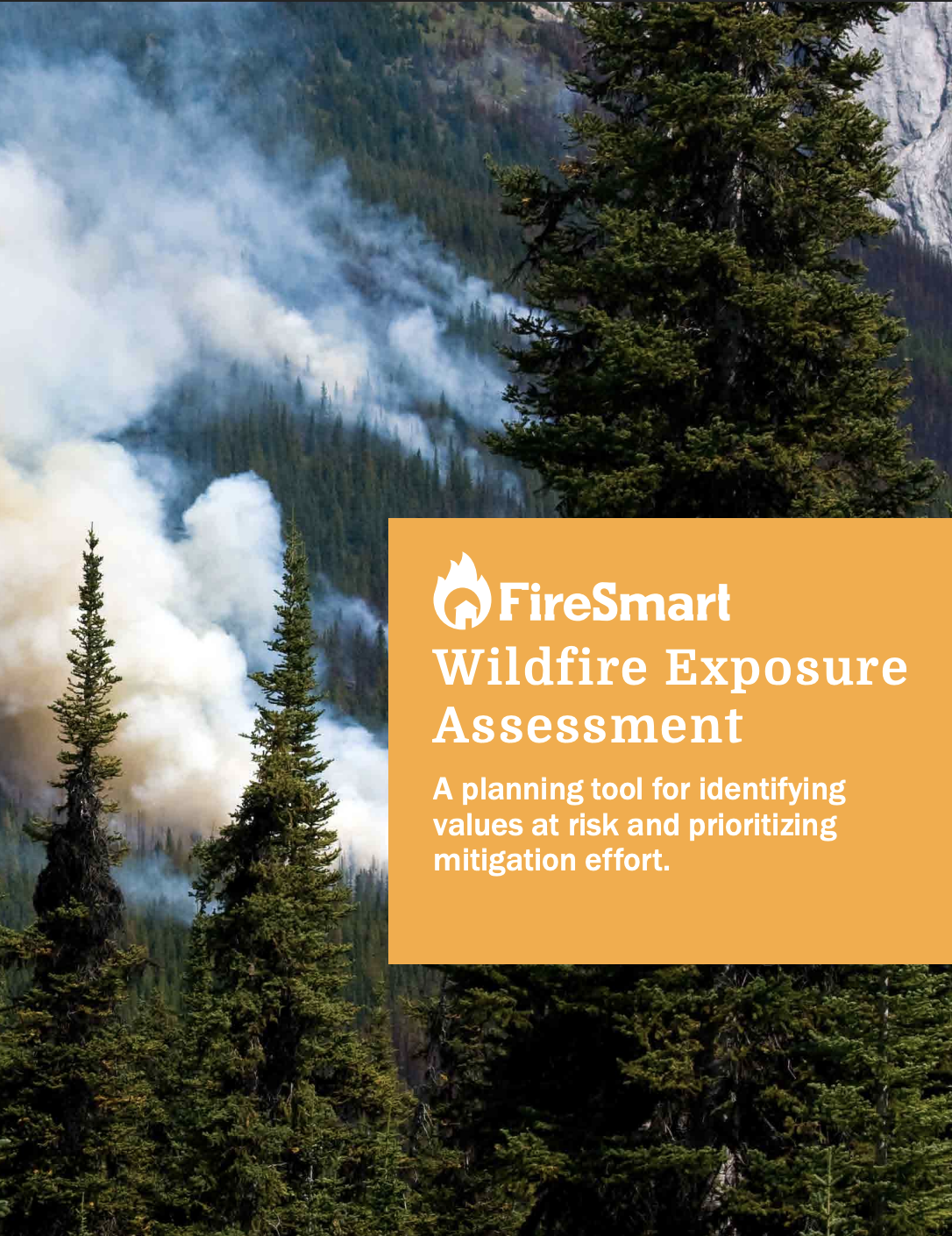
FireSmart Wildfire Exposure Assessment
This guide explains the Wildfire Exposure Assessment. You will learn about the steps taken to complete the assessment and the meaning of the results. You may be a homeowner, a municipal or government employee, a FireSmart consultant, or part of the many other organizations involved in protecting communities from wildfire. If you are concerned about protecting your home, neighbourhood or other values from wildland fire, the findings of a Wildfire Exposure Assessment can help you take action – and this guide explains how it all works.
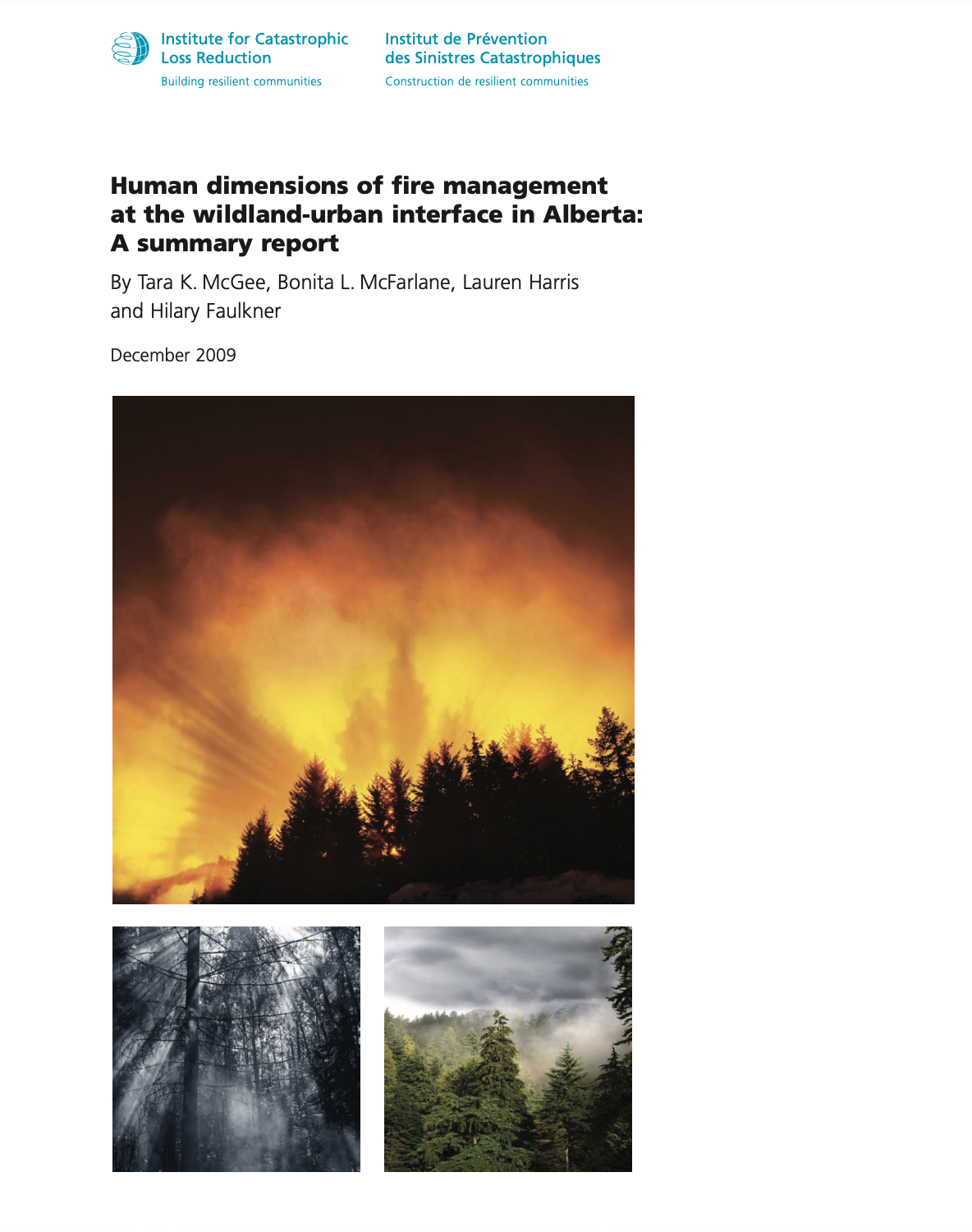
Human dimensions of fire management at the wildland-urban interface in Alberta: A summary report
This report presents the results of two studies that were undertaken to examine wildfire risk mitigation at the wildland-urban interface in Alberta, Canada. One study examined homeowner adoption of mitigation measures and factors that influence adoption in six communities. The second study examined adoption of wildfire risk management programs by 18 municipal governments in Alberta. Implications for policies and programs are discussed.
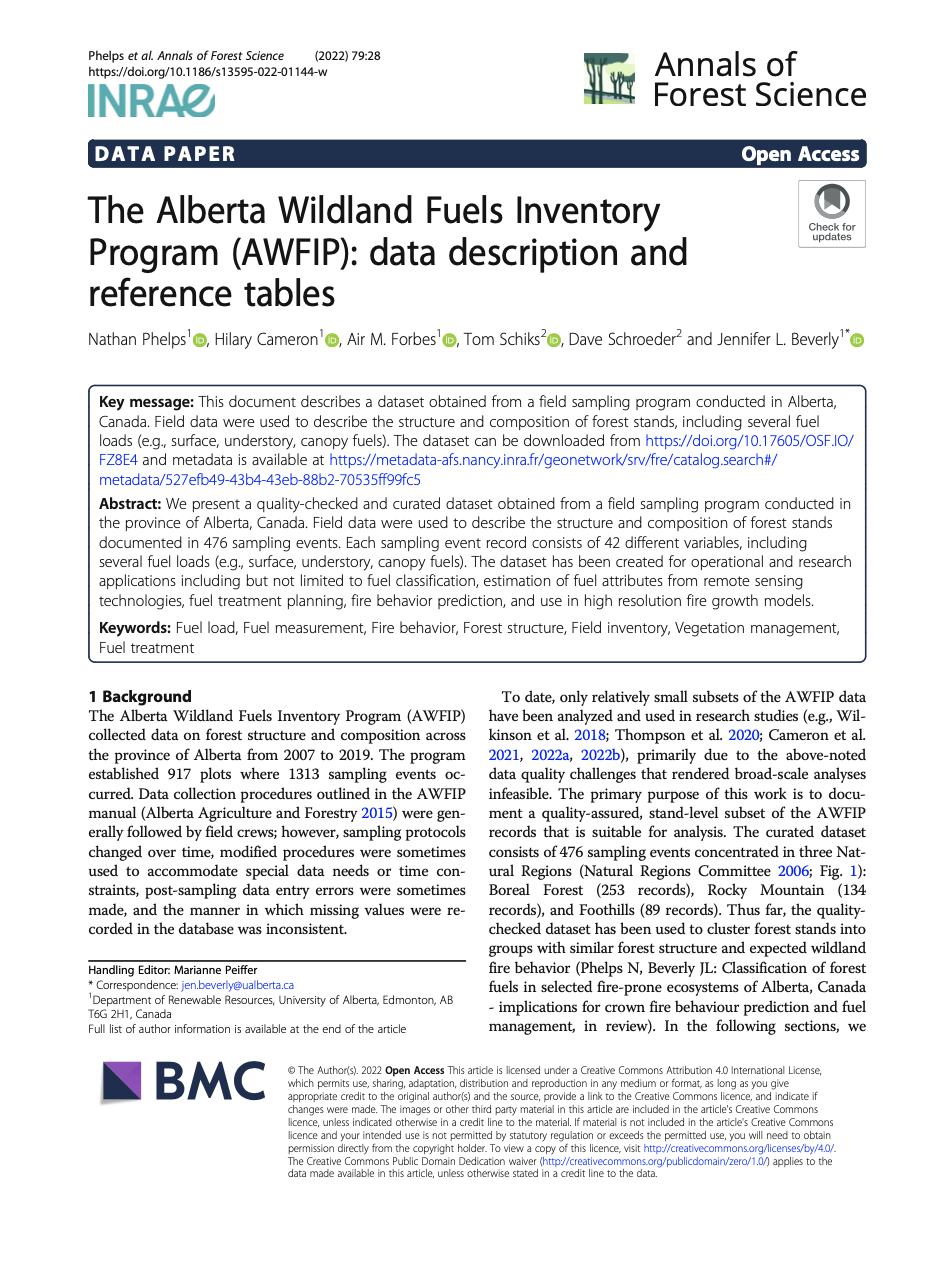
The Alberta Wildland Fuels Inventory Program (AWFIP): data description and reference tables
We present a quality-checked and curated dataset obtained from a field sampling program conducted in the province of Alberta, Canada. Field data were used to describe the structure and composition of forest stands documented in 476 sampling events. Each sampling event record consists of 42 different variables, including several fuel loads (e.g., surface, understory, canopy fuels). The dataset has been created for operational and research applications including but not limited to fuel classification, estimation of fuel attributes from remote sensing technologies, fuel treatment planning, fire behavior prediction, and use in high resolution fire growth models.