Fuel Management
This collection is intended to equip land managers and decision-makers with knowledge needed to increase the uptake of research outcomes in fuel management, implement best practices for wildfire resilience actions, and understand how such actions intersect with interacting land values. These resources encourage the development of place-based approaches and the knowledge exchange essential to turning science and experiential knowledge into policy and practice.
Resources in this collection
Basic principles of forest fuel reduction treatments
We summarize a set of simple principles important to address in fuel reduction treatments: reduction of surface fuels, increasing the height to live crown, decreasing crown density, and retaining large trees of fire-resistant species. Thinning and prescribed fire can be useful tools to achieve these objectives. Low thinning will be more effective than crown or selection thinning, and management of surface fuels will increase the likelihood that the stand will survive a wildfire. Five empirical examples of such treatment are discussed. Applying treatments at an appropriate landscape scale will be critical to the success of fuel reduction treatments in reducing wildfire losses in Western forests.
Comparative results of ignition probability and fire behaviour among landscaping mulch products
Mulch products are commonly used as landscaping material around residential structures and community parks. FPInnovations compared the ignition probability and fire behaviour of six different landscaping mulch products at the request of the Regional Municipality of Wood Buffalo, which includes the urban service area of Fort McMurray. The results of this study will help communities and home owners make informed decisions regarding the use of landscaping mulch products.
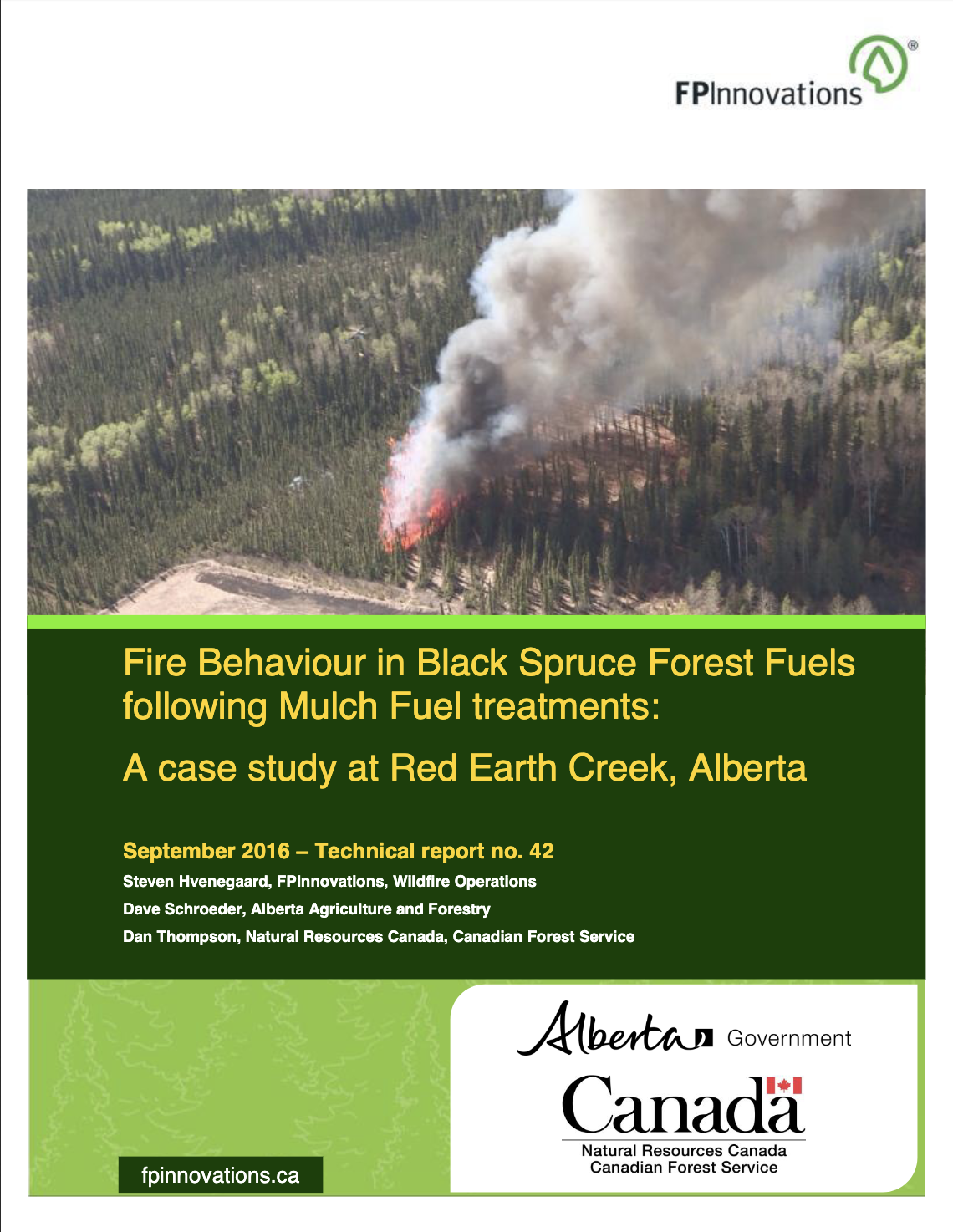
Fire behaviour in black spruce forest fuels following mulch fuel treatments: A case study at Red Earth Creek, Alberta
Alberta Agriculture and Forestry (AAF) Wildfire Management Branch fuels managers designed the Red Earth Creek FireSmart research area with the objective of conducting research that will lead to a better understanding of mulch fuel treatments and how these changes in the black spruce fuel environment affect fire behaviour. On May 14, 2015, Slave Lake Forest Area personnel conducted an experimental fire at this site; FPInnovations and research partners collected data to document changes in fire behaviour.
Fire behaviour in simulated mountain pine beetle-killed stands, final report
The objective of this study is to determine and document fire behaviour in pine stands with severe mortality due to the Mountain Pine Beetle. Specifically, we aim to evaluate the differences in (1) crown fire ignition and (2) crown fire rates of spread between (a) green trees and green-attack trees and (b) green trees and red-attack trees.
Fire behaviour in thinned jack pine: Two case studies of FireSmart treatments in Canada’s Northwest Territories
Reducing risk of loss due to wildfire is enhanced when forest fuels surrounding communities and individual structures are properly managed and are a part of the FireSmart concept. This report describes two test burns where a crown fire was burned into a fuel-managed plot following FireSmart guidelines (Partners in Protection 2003). In both cases the crown fire changed to a surface fire as the fire passed into the fuel-managed plots.
Fire Management Stocking Standards Guidance Document
Stocking standards provide the basic linkage between the harvest of a forest stand and the regeneration of a new stand and are a required element of forest stewardship plans under the Forest and Range Practices Act (FRPA). Stocking standard guidance for even-aged management has been developed for biogeoclimatic subzones, variants and site series that produce commercially valuable timber, as well as for special considerations including habitat and multi-storied stands.
Forest fuel treatment productivity research in Alberta: A synthesis of results and findings
Forest fuel treatments are applied across a broad range of ecosites in Alberta and Canada, with an overarching goal of managing hazardous fuel buildup to mitigate wildfire. These treatments use various manual and mechanical processes to achieve fuel treatment objectives. Planning and application of a specific forest fuel treatment technique is often shaped by several factors, including objectives of the fuel treatment, availability of resources (personnel and equipment), and commitment to using local resources (socio-economics). In addition, site conditions in certain ecosites will favour the application of some treatment techniques over others. With the broad nature of numerous fuel treatment techniques applied over a wide range of environmental conditions, it is difficult to document all treatments and develop comparative productivity and cost evaluations. This summary of fuel treatment studies accesses current research to present relevant findings and identify knowledge gaps in research on stand-level fuel treatment productivity.
Fuel treatment effectiveness at the landscape scale: a systematic review of simulation studies comparing treatment scenarios in North America
The risk of destructive wildfire on fire-prone landscapes with excessive fuel buildup has prompted the use of fuel reduction treatments to protect valued resources from wildfire damage. The question of how to maximize the effectiveness of fuel reduction treatments at landscape scales is important because treating an entire landscape may be undesirable or unfeasible. We reviewed 86 simulation studies that examined landscape-scale fuel reduction treatment effectiveness for landscapes of the USA or Canada. Each of these studies tested effects of fuel reduction treatments on wildfire through comparisons of landscape scenarios differing by treatment design or other attributes. Results from these studies were summarized to assess what they reveal about factors determining fuel treatment effectiveness at landscape scales.
Getting back to fire suméŝ: exploring a multi-disciplinary approach to incorporating traditional knowledge into fuels treatments
Evaluating fuel treatment effectiveness is challenging when managing a landscape for diverse ecological, social, and economic values. We used a Participatory Geographic Information System (PGIS) to understand Confederated Colville Tribal (CCT) member views regarding the location and effectiveness of fuel treatments within their ancestral territory within the Colville National Forest (CNF) boundary. The 2015 North Star Fire burned 88 221 ha (218 000 acres) of the CCT ancestral territory.
Integrating fire-smart fuels management with bioenergy benefits remote and Indigenous communities in Canada
The global urgency of more damaging wildfires calls for proactive solutions. Integrating fire-smart fuels management with bioenergy could reduce wildfire risk while providing feedstock for bioenergy. We explore this strategy in off-grid communities in Canada who are heavily dependent on diesel for their energy needs, many of which are home to Indigenous peoples. Combining national remote sensing data and community-based information, we identify 33 diesel-dependent communities at high wildfire risk due to a large accumulation of undisturbed flammable forest. We demonstrate that 30 of these 33 communities could theoretically meet their annual energy needs by harvesting less than 1% of the surrounding biomass, which with thoughtful planning could constitute effective fuel treatments. Given the growing wildfire risk and the need for energy security in Indigenous communities, Indigenous leadership, and collaboration with wildland fire agencies, are essential for developing integrated fuel management strategies and identifying synergies with the bioenergy sector.
Landscape-scale fuel treatment effectiveness: lessons learned from wildland fire case studies in forests of the western United States and Great Lakes region
Maximizing the effectiveness of fuel treatments at landscape scales is a key research and management need given the inability to treat all areas at risk from wildfire. We synthesized information from case studies that documented the influence of fuel treatments on wildfire events. We used a systematic review to identify relevant case studies and extracted information through a series of targeted questions to summarize experiential knowledge of landscape fuel treatment effectiveness. Within a larger literature search, we identified 18 case study reports that included (1) manager assessment of fuel treatment effectiveness during specific wildfire events; (2) fuel treatment effects on fire size, severity, and behavior outside of the treatment boundaries; and (3) the influence of fuel treatments on fire suppression tactics.
Opportunities and limitations of thinning to increase resistance and resilience of trees and forests to global change
We reviewed recent literature to identify the positive and negative effects of thinning on both stand- and tree-level resistance and resilience to four stressors that are expected to increase in frequency and/or severity due to global change: (1) drought, (2) fire, (3) insects and pathogens, and (4) wind. While our review suggests that thinning should not be promoted as a tool that will universally increase the resistance and resilience of forests, current evidence suggests that thinning could still be an effective tool to reduce forest vulnerability to several stressors, creating a window of opportunity to implement longer term adaptive management strategies such as assisted migration. We highlight knowledge gaps that should be targeted by future research to assess the potential contribution of thinning to adaptive forest management.
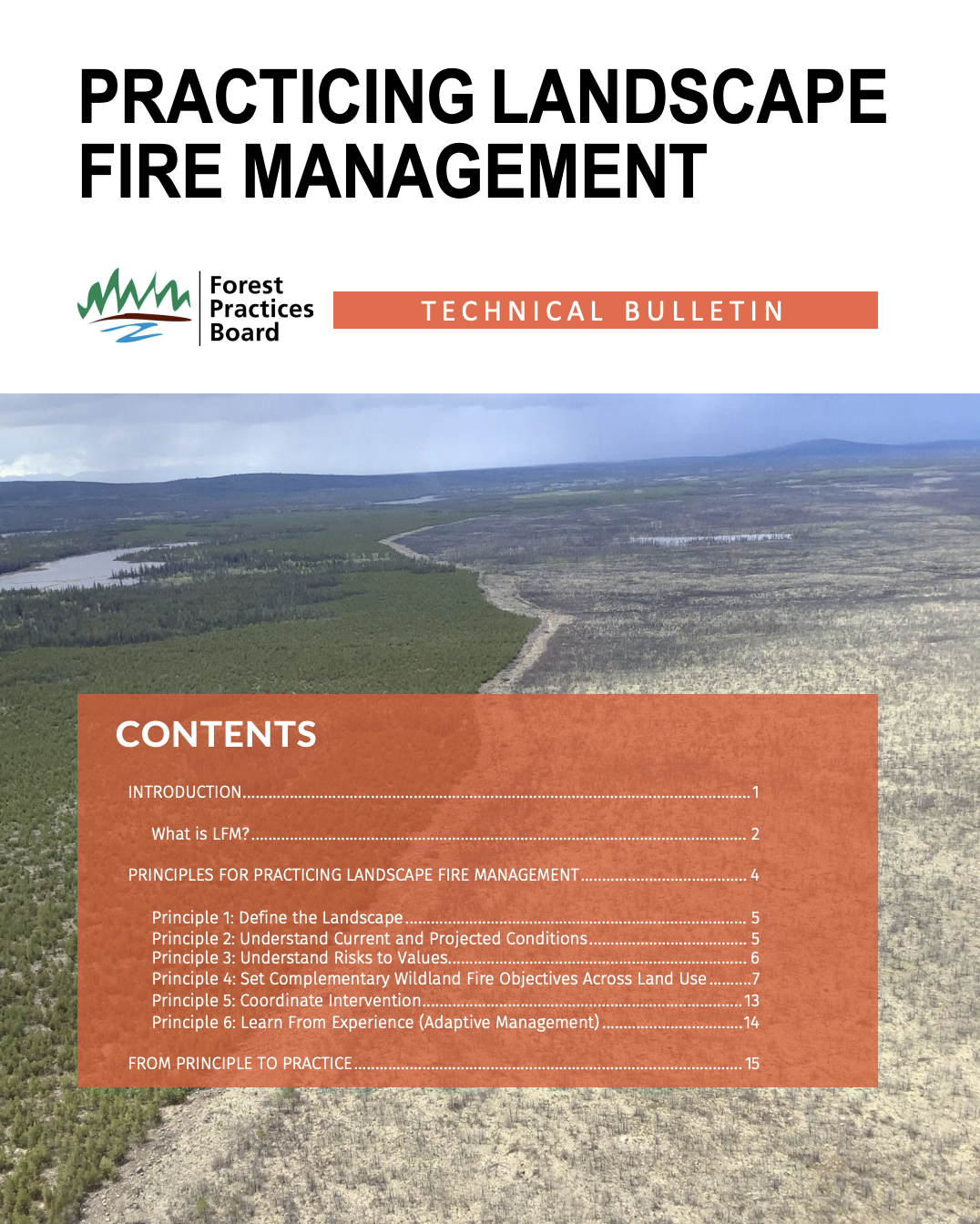
Practicing Landscape Fire Management: Technical Bulletin
The Forest Practices Board has produced a technical bulletin to help land managers put Landscape Fire Management into practice. The bulletin describes six key principles for practicing landscape fire management and includes practical examples of how these principles can be incorporated into planning and practice. It is designed for land managers working for provincial, Indigenous and local governments, as well as industry.
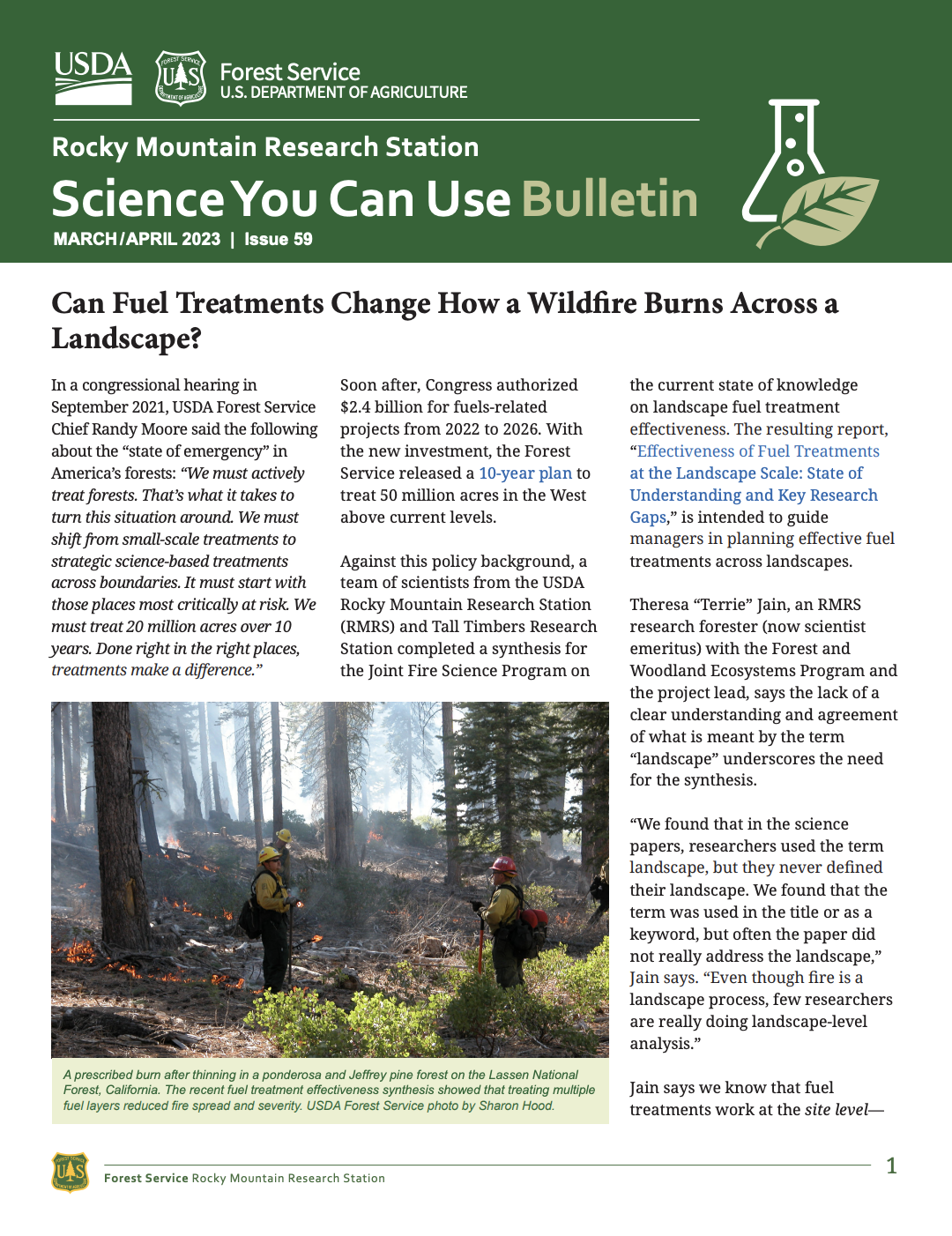
Science You Can Use Bulletin: Can fuel treatments change how a wildfire burns across a landscape?
Science You Can Use is a publication of the USDA Forest Service Rocky Mountain Research Station that summarizes and synthesizes current scientific research. In this issue: By all measures, wildfires in the western United States are becoming more extreme. Fires are growing larger and burning more intensely, and suppression costs are spiraling upward. Maximizing the effectiveness of fuel treatments at the landscape scale is key given limited resources and the inability to treat all areas likely to burn in a wildfire.
Stand conversion for wildfire risk mitigation management strategies
This review explores the benefits, challenges, limitations, logistics, and cost-effectiveness of different management options to convert conifer-dominated stands to aspen-dominated stands. These alternatives can include overstory removal (harvesting, bulldozing, shear blading, prescribed burning) and site preparation (root trenching, drag scarification, broadcast burning) treatments. On sites where parent aspen trees are not present in the original stand, tree planting will be necessary albeit costly in comparison to regeneration by suckering. While extensive literature exists on the regeneration of trembling aspen through suckering, research on artificial establishment with seedlings and its requirements is still in its infancy and rapidly developing.
Wildfire research to evaluate the effectiveness of fuel treatments
Over the last two decades, FPInnovations has studied the effectiveness of fuel treatments through several evaluative processes. These studies have been conducted in collaboration with various wildfire agencies, reseaerch institutes and international collaborators. This is the resulting presentation.