Technology and Innovation
This collection showcases resources helping to accelerate innovation and support the integration and implementation of proven solutions in wildfire management. Intended for both end-users and innovators, it focuses on meaningful solutions and creative collaborations.
Resources in this collection
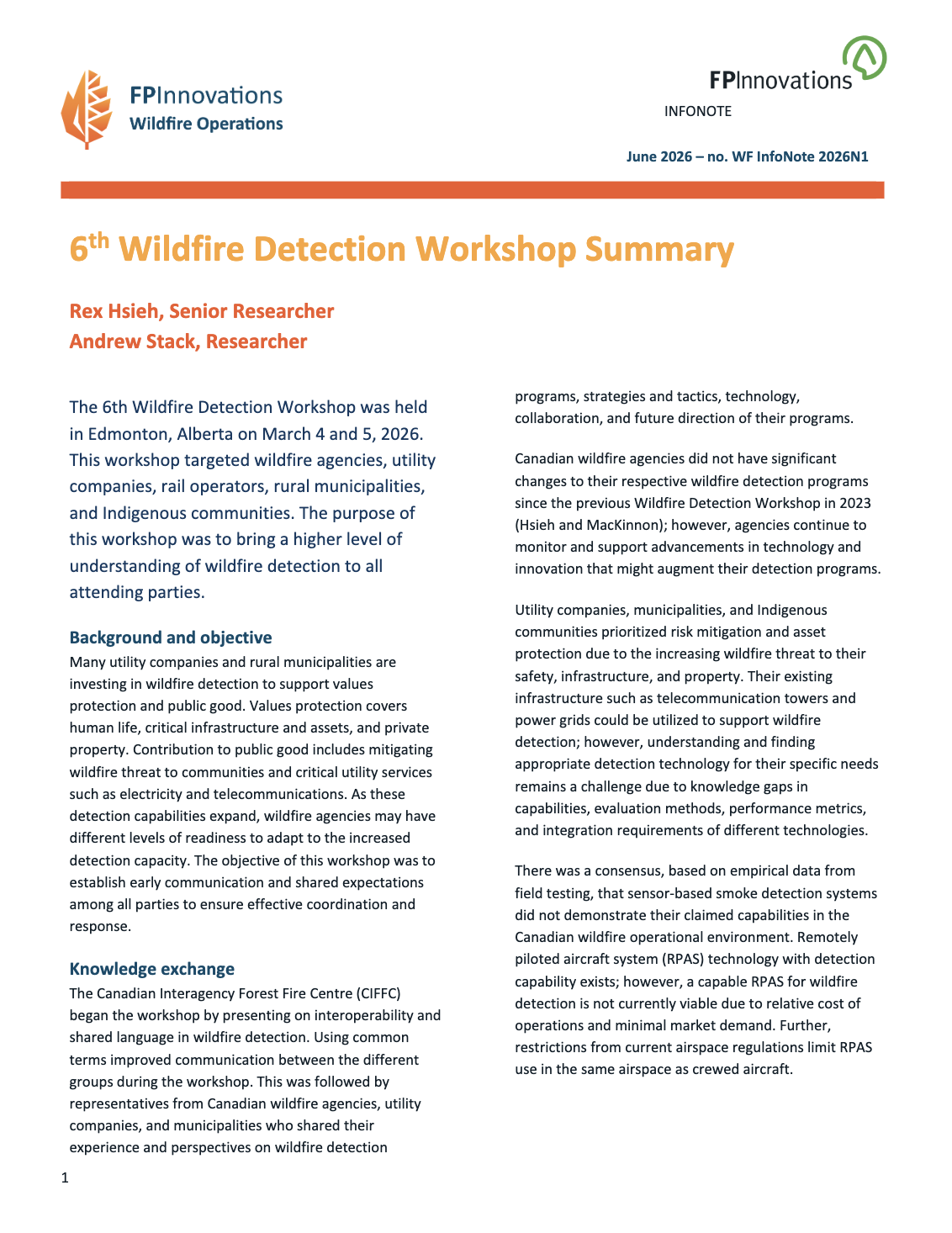
6th Wildfire Detection Workshop Summary
The 6th Wildfire Detection Workshop was held in Edmonton, Alberta on March 4 and 5, 2026. This workshop targeted wildfire agencies, utility companies, rail operators, rural municipalities, and Indigenous communities. The purpose of this workshop was to bring a higher level of understanding of wildfire detection to all attending parties.
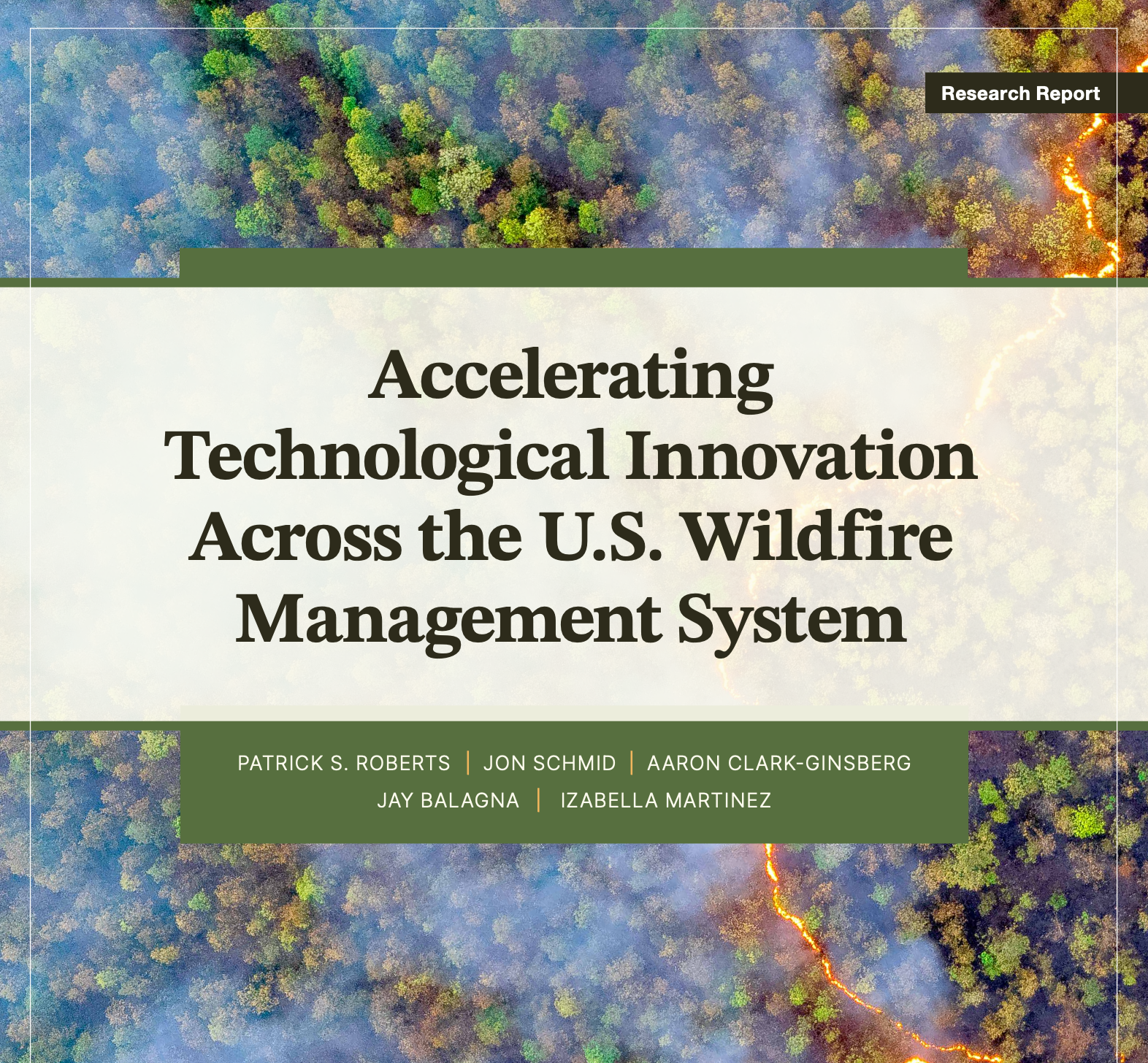
Accelerating Technological Innovation Across the U.S. Wildfire Management System
Researchers combined a literature review with stakeholder interviews to assess how wildfire technology innovations move from idea to field use and to identify when and how innovation stalls. The team traced the system of federal, state, local, tribal, nonprofit, and private actors to locate choke points throughout the innovation pipeline. In parallel, the researchers studied models from four government-led innovation organizations — the Defense Advanced Research Projects Agency, the Advanced Research Projects Agency–Energy, the Defense Innovation Unit, and In-Q-Tel — to identify transferable practices to accelerate innovation.
Alberta wildfire detection challenge: Operational demonstration of six wildfire detection systems
Detection is critical for successful wildfire management. The Alberta Wildfire Detection Challenge was a collaborative program between Alberta Wildfire, Alberta Innovates, and FPInnovations. The program selected six commercially available fixed detection systems for a challenge. These systems were installed and operated on the Marten Mountain Lookout tower near Slave Lake, Alberta, Canada during the 2022 wildfire season. This report presented analyzed performance data of these systems from the demonstration in an operational environment. Results will facilitate a better understanding of these systems.
Application of Technology and Innovation in Wildland Fire: Summary Report (2021-22)
In 2021, Alberta Agriculture and Forestry’s Wildfire Management Branch identified an opportunity to evaluate new and emerging technologies to supplement and improve current wildfire response capabilities. A one-year directed research initiative was undertaken with the FPInnovations’ Wildfire Operations group to assess the efficacy of five different technologies and their utility in the wildfire domain. This report summarizes the five projects undertaken in this initiative, highlighting key outcomes and considerations.
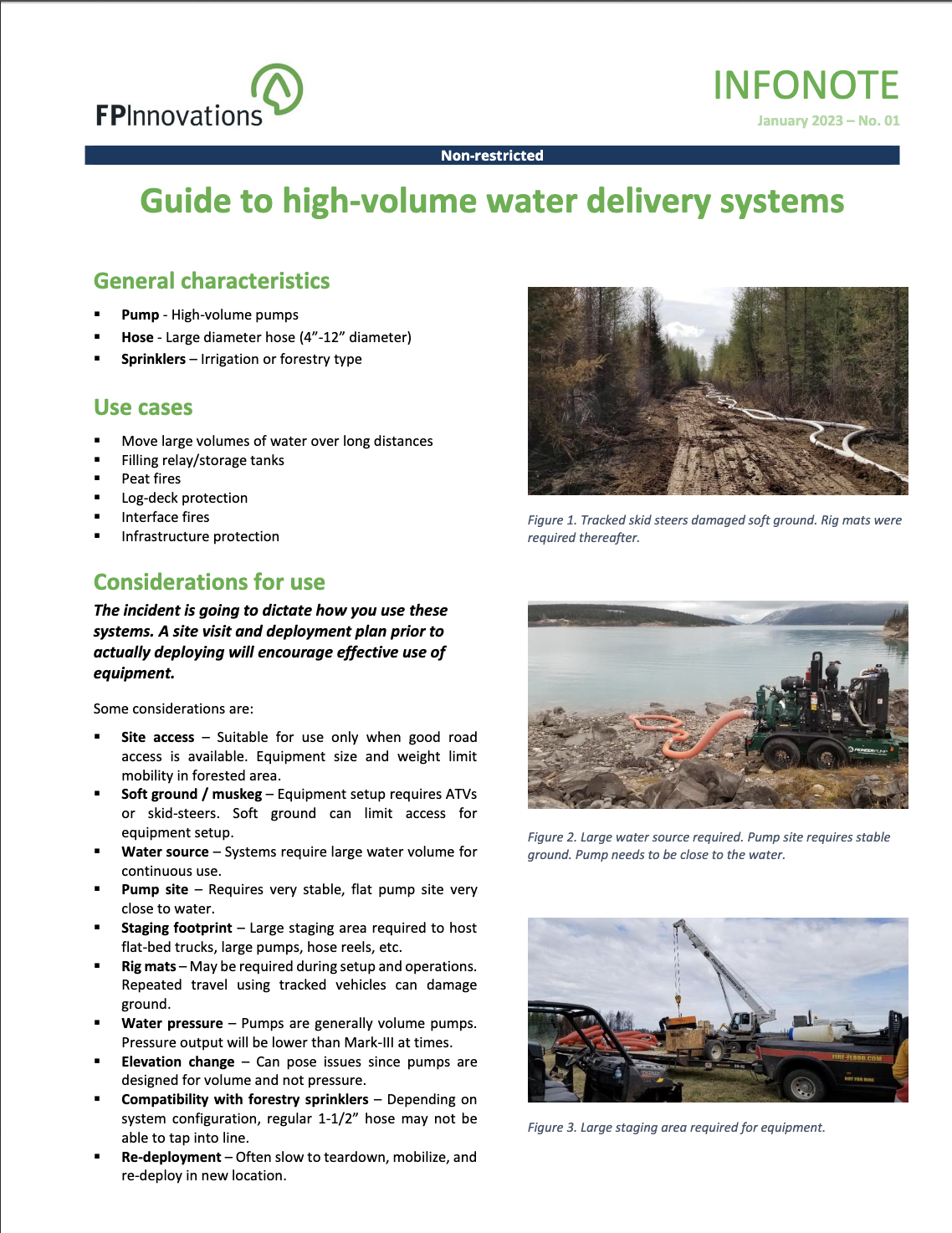
Guide to high-volume water delivery systems
This briefing describes the general characteristics and use cases for high-volume water delivery systems. Performance estimates are also listed.
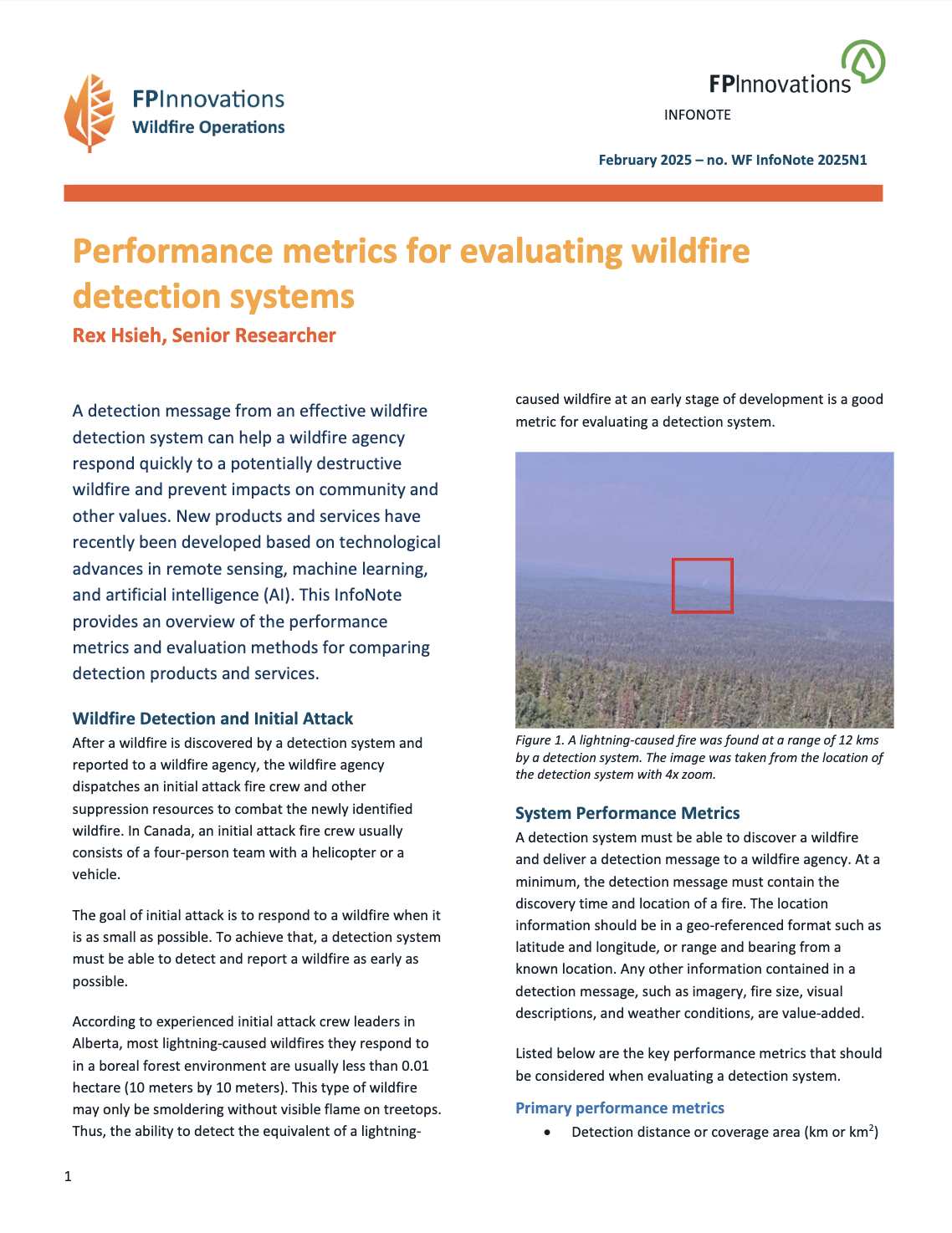
Performance metrics for evaluating wildfire detection systems
A detection message from an effective wildfire detection system can help a wildfire agency respond quickly to a potentially destructive wildfire and prevent impacts on community and other values. New products and services have recently been developed based on technological advances in remote sensing, machine learning, and artificial intelligence This InfoNote provides an overview of the performance metrics and evaluation methods for comparing detection products and services.
Responsible FireTech Framework and Innovation Playbook
Building on the Responsible FireTech Framework (RFTF), longitudinal survey data, & frontline insights from the FireTech Podcast, the Playbook will translate principles into practical guidance — offering shared methodologies, governance models, readiness criteria, and real-world case studies for designing, testing, validating, and scaling FireTech responsibly.
State-of-practice of water delivery systems (sprinklers) used in the wildland-urban interface, compendium
Sprinklers are used to protect structures from wildfire during wildland-urban interface (WUI) events across Canada. Traditionally, standard forestry equipment has been used in conjunction with impact sprinklers. Agencies are trying to determine if the standard practices and equipment used in wildfire suppression operations are the most effective for community structure protection. The Forest Resource Improvement Association of Alberta has engaged with FPInnovations to conduct a state-of-practice review of water delivery systems (sprinklers) used in the wildland-urban interface.